
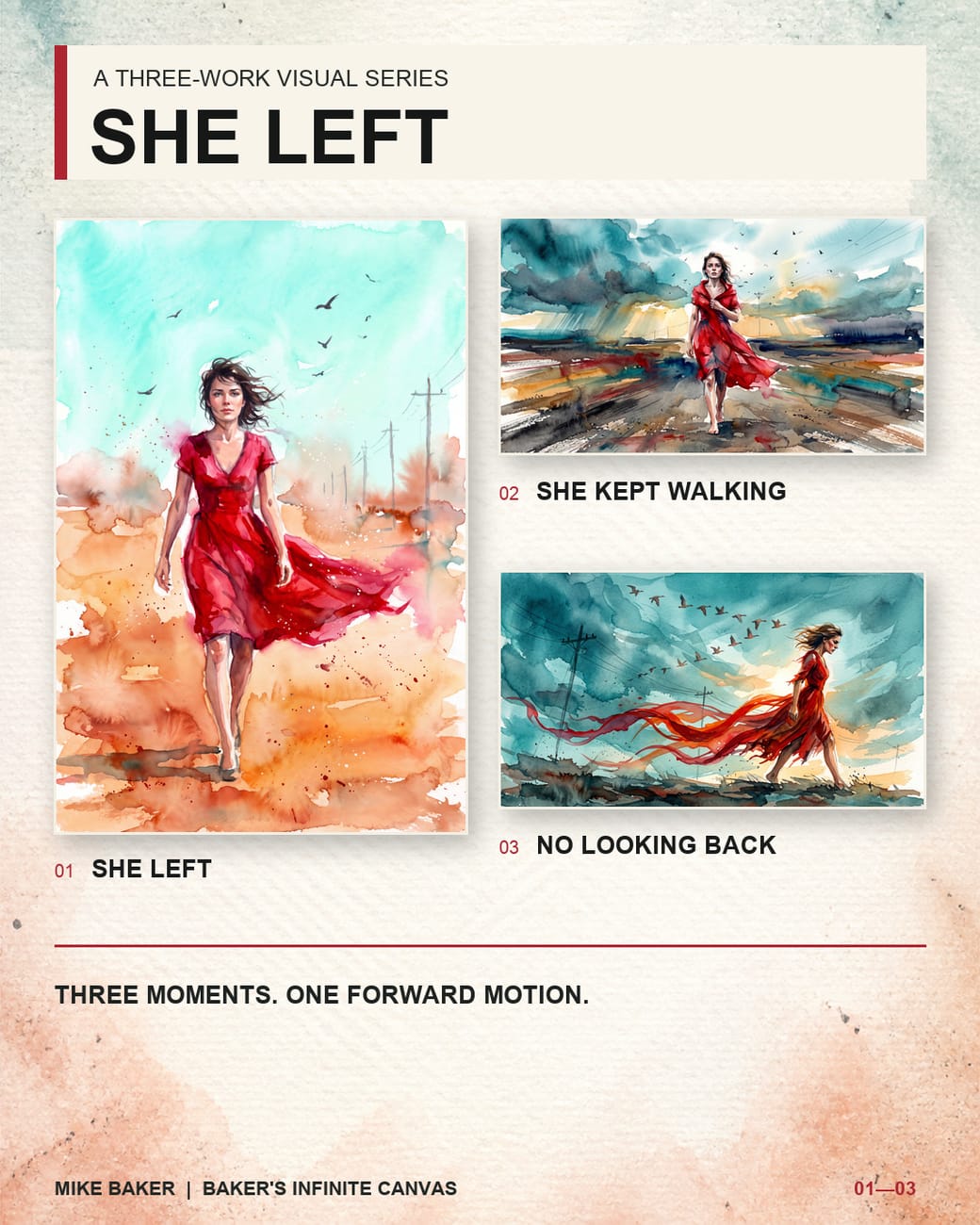
I did not set out to make three images about a woman leaving. I started with a woman in a red dress walking through an open landscape, and I knew more about how I wanted the image to feel than I knew about her. I wanted movement in the dress and the sky. I wanted the landscape to feel a little uncertain without becoming apocalyptic or overly dramatic. Most of all, I wanted something in her expression that suggested we were meeting her after a decision had already been made. I did not know what the decision was, and I did not think I needed to know yet.
That is fairly typical of the way I create. I have spent a lot of my life assuming I should know where an idea is going before I start working on it, and my actual creative process has given me plenty of evidence that I do not work that way. Sometimes I begin with a sentence. Sometimes I hear part of a song in my head. With art, I often have an emotional idea that is annoyingly specific in how it should feel and completely unhelpful about what it should actually look like. I start experimenting, reject a ridiculous number of images, change the composition, try another direction, come back to something I abandoned twenty minutes earlier, and eventually there is a version that makes me sit with it longer than the others.
That happened with this woman.
There were versions of the first image that were more detailed and others that were more conventionally beautiful. Some were technically impressive in a way that would have been easy to mistake for finished. I have learned to distrust that reaction a little. AI image tools are extraordinarily good at giving you something impressive. They are also extraordinarily good at giving you an endless supply of images that I feel absolutely nothing about. Having access to more possibilities has made the ability to reject them one of the most important parts of my process.
The image I kept had something quieter in her face. She looked tired enough for me to believe she had been through something, but I did not see defeat there. The wind was pulling at her dress and moving the world around her while she continued toward us. I remember looking at it and understanding the title before I understood anything else about the story.
She Left.
I liked how little those two words explained. I still do.
Leaving some of the story unfinished
My first instinct as a writer is often to explain things. I like context. I like understanding why someone did what they did, what happened before, what it cost, and what they learned afterward. The more time I spend creating visual art, the more I appreciate what happens when I resist that instinct and give the person looking at the work some room.
I could tell you this woman left a terrible marriage, and suddenly the entire image would narrow around that story. I could say she walked away from a job, a faith, a hometown, or a family that never let her become herself, and each explanation would change what you saw. All of those stories interested me, which was a good indication that I should choose none of them. I wanted the emotional truth of leaving without deciding that every person who looked at her had to arrive through the same circumstances.
There is also something important to me about the possibility that what she left was complicated. Maybe there were good years inside it. Maybe she loved somebody who could no longer be healthy for her. Maybe she spent a long time trying to make something work and still wondered whether another six months would have changed anything. Human beings rarely leave perfectly clean situations with every feeling lined up behind the decision. Sometimes the right choice still hurts. Sometimes relief and grief show up together, and neither one invalidates the other.
I started thinking about all of that after the image existed, which is part of why I enjoy this process so much. Creating an image gives me another way into a question. Writing asks me to put language around an experience. Music lets me stay in emotion longer without explaining every piece of it. Visual art lets me put something in front of you and discover what I think by paying attention to my own reaction.
That has become a large part of Baker’s Infinite Canvas for me. I am using AI-assisted tools, and I am very open about that because pretending otherwise would make the conversation around the work less interesting. I am fascinated by the technology, but fascination alone would not keep me doing this. What keeps me up far too late is the possibility of getting close to an image I have carried in my head and then discovering that the finished piece says something I had not completely understood when I began.
I wanted to know what happened next
I could have stopped with She Left. It worked as a single piece, and there is always some danger in returning to an idea after you have made something you like. I have done enough creative work now to know how easily you can beat the life out of a good idea by deciding it needs a sequel, a series, six versions, merchandise, a soundtrack, and apparently its own cinematic universe by Thursday.
This time I kept thinking about what happened the next morning.
The actual act of leaving gets most of the attention in stories because it gives us a moment we can see. Someone packs a bag, closes a door, says goodbye, drives away, or finally speaks words they have been rehearsing quietly for months. There is a before and an after, and that makes the scene easy to understand. Real life keeps going once the dramatic part is over, and I became much more interested in that part of her story.
What does day seventeen look like? What happens when nobody is telling you how brave you were anymore? What happens when the new life still feels strange and the old one starts benefiting from the selective memory that tends to make familiar things look safer from a distance? I wondered about the mornings when she might have questioned herself and the people she might have missed. I thought about how much strength gets spent maintaining a decision after the moment of certainty that created it has passed.
That was where She Kept Walking came from.
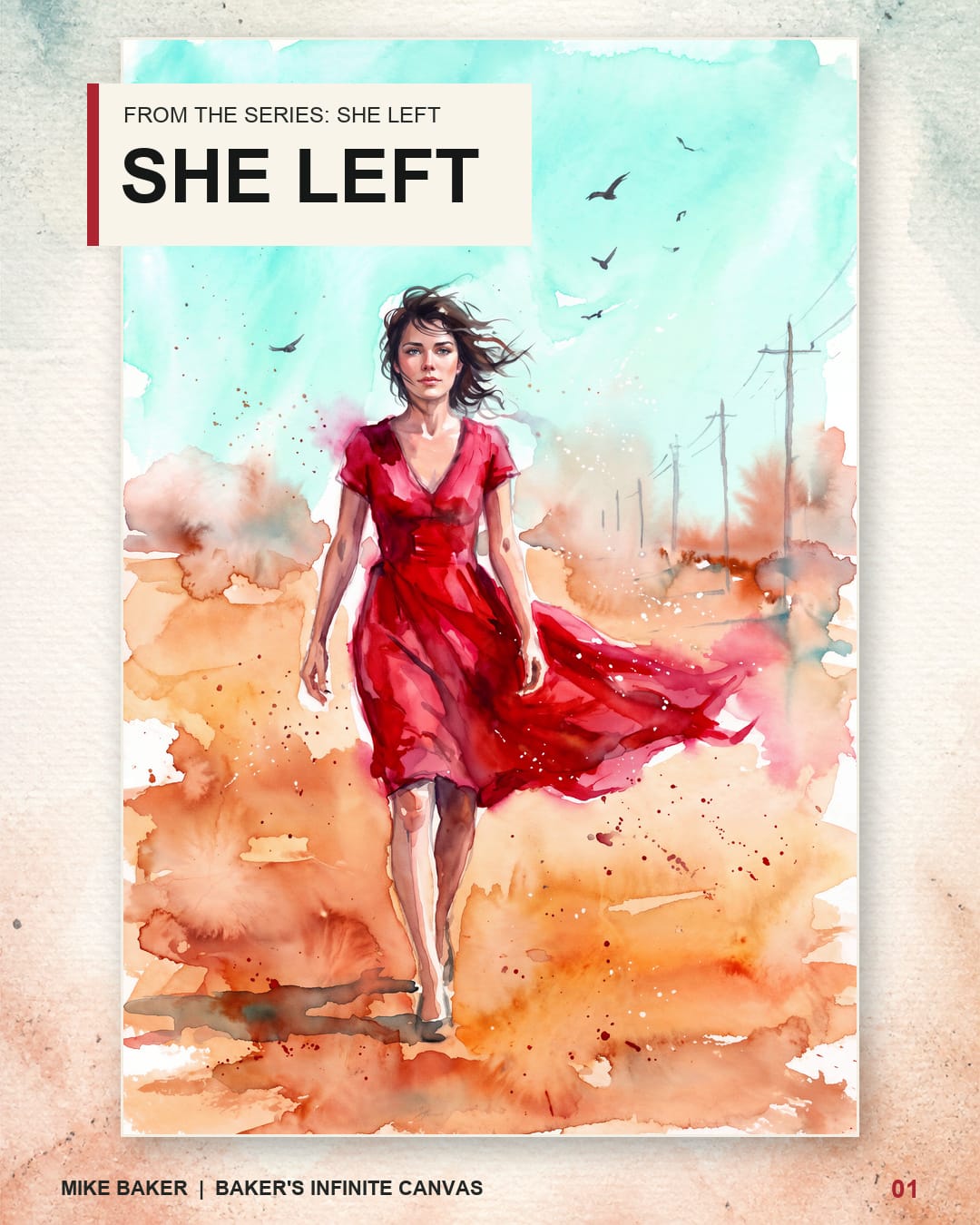
I wanted the second image to carry some of that weight. The sky became heavier and the landscape more difficult. She is farther away from us and looks more vulnerable to me. The road has become a bigger part of the image, because by then I was thinking less about departure and more about endurance. She has already done the thing people might describe as brave. Now she is doing something much less visible. She is living through what came after.
The words I paired with it were, “Leaving can happen in a single moment. Staying gone is a decision made again and again.” I still think that gets close to what I was trying to understand. A major decision rarely resolves all the feelings that made the decision difficult in the first place. We carry history with us, and sometimes we have to make the same choice in smaller ways for a long time before the new direction feels like our own life.
I think that is true far beyond leaving relationships or places. Anyone who has changed something significant about their life understands some version of it. You make a decision about drinking and then have to make another decision at dinner with friends. You leave a job and later have a terrible day somewhere else and wonder if the old situation was as bad as you remembered. You set a boundary with somebody you love and discover that missing them does not make the boundary less necessary. You decide to live differently and then learn that becoming different is slower than deciding to change.
Those are the parts of human stories that interest me most. I am less interested in the clean victory lap than I am in the person several weeks later trying to keep a promise they made to themselves when they were thinking clearly.
By the third image, she had changed
When I started working on the third piece, I knew almost immediately that she could not keep walking toward us. The first two images let us study her face and stay close to the emotional effort. Continuing that composition would have made the third piece feel like another variation of the same idea, and by then I felt differently about her.
She did not need to explain herself anymore.
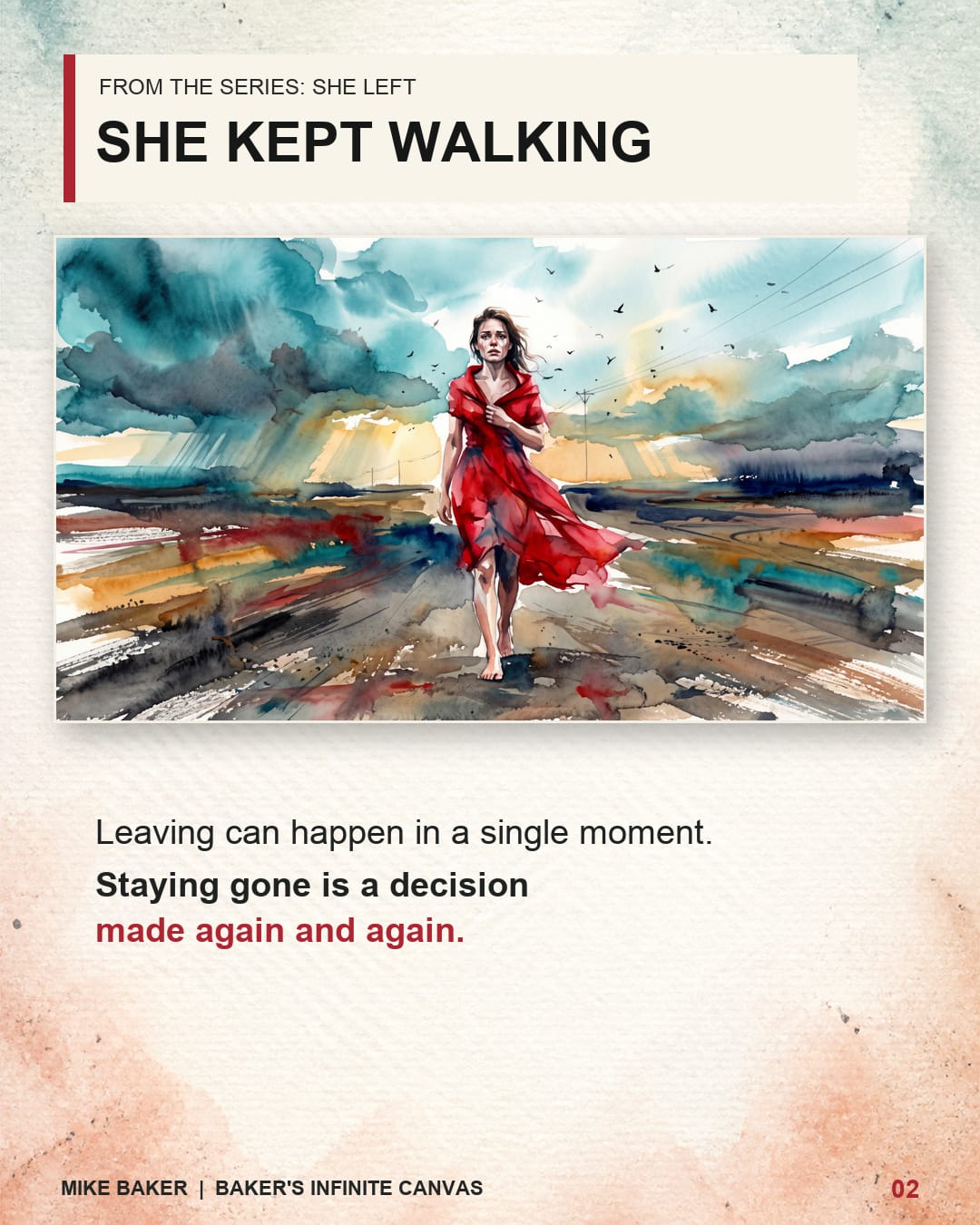
In No Looking Back, she moves across the frame with her attention ahead of her. The dress trails behind her and still occupies a large part of the image, which I liked because I did not want the past to disappear. I have never believed that getting through something means becoming untouched by it. We carry people, experiences, mistakes, love, grief, anger, and pieces of earlier versions of ourselves long after we have decided where we are going next. A meaningful life leaves marks.
What felt different in the third image was the amount of authority those things had over her direction. She knows they are behind her without needing to keep checking.
That distinction kept growing on me after the series was finished. There are experiences I will carry for the rest of my own life. Some are beautiful and some still hurt. I have decisions I would make differently with what I know now and periods of my life I understand much better from the other side. I do not want to erase any of that because it belongs to the person I became. I do want to keep learning how to remember the past without automatically handing it control over the future.
Looking at the three images together, I started to see that I had made something broader than the story I thought I was following. Leaving was the visible action, but the part that held my attention was change itself. I was watching somebody move through the uncomfortable distance between recognizing that her life needed to change and eventually living far enough into that choice that she stopped needing the old life to confirm she had been right.
I know that distance.
I think most of us do.
What making art has become for me
I came into visual art from a strange direction because I have never pretended I suddenly learned to paint watercolors like the people whose technical skill I admire. AI opened a door that previously felt closed to me. I could see images in my head and imagine entire visual worlds, but there was a wide distance between seeing them and having the traditional skills to put them on a canvas. These tools changed that distance, and once I started exploring them I discovered I had much more to say visually than I expected.
The early work was tied closely to endometriosis advocacy. I was trying to make women living with pain feel strong, seen, and believed, especially after watching what endometriosis had done inside my own family. Those warrior images taught me something important because people responded to them in ways I had not anticipated. Someone would see an image I had created for one reason and attach a completely different piece of her own life to it. The art created an opening for a conversation that might never have happened through an informational post or another paragraph about a disease.
That stayed with me.
It also changed the questions I ask while I am making something. I care about whether an image is beautiful, but beauty alone gets boring quickly. I want to know what a person feels when they look at it and where their eye goes first. I wonder whether the expression feels human or posed, whether the symbolism is helping or becoming obvious, whether I have added something because the story needs it or because the software made it easy. I have learned that removing one dramatic element often improves the image more than adding five new ones.
There is a lot of trial and error in this. Sometimes the woman suddenly has six fingers, although the technology is getting much better about that particular nightmare. Sometimes the composition goes somewhere bizarre. More often, the problem is subtler. The picture looks fine and simply has no pulse for me. I might generate or revise dozens of versions before finding the one that holds my attention, and even then I keep adjusting it because “almost” is one of the most frustrating places to land creatively.
That is where the human part of AI-assisted art lives for me. The technology gives me an enormous range of possibilities. I bring the reason I am there in the first place, along with my taste, experience, curiosity, judgment, memories, and the story I am trying to get closer to. I decide what survives. I am responsible for what carries my name when the work leaves my computer.
I also know that my interpretation only gets it so far.
The part I do not control
One of the best things that has happened since I started sharing creative work publicly is having people tell me what something meant to them and realizing they found something I never deliberately put there. That happened with the advocacy art, and it happens with songs and writing too. Someone hears a lyric about one experience and thinks about their father. A person reads something I wrote about leadership and sees their marriage in it. An image intended to explore one kind of loss reminds somebody else of the day they finally chose themselves.
I love that.
There was a time when I might have worried that they misunderstood the work. I think differently now. If I make something honest enough to give another person access to their own story, I do not need to correct their interpretation. I already had my experience of creating it. They get to have theirs.
That is why I never decided what the woman in She Left was escaping or moving toward. I know some of what she means to me now, but I want the person who sees her after a difficult divorce to have her. I want someone leaving a career after twenty years to see something else. I want the person rebuilding after grief, questioning a belief they inherited, recovering from illness, getting sober, moving across the country, or finally admitting that an old version of life no longer fits to bring whatever they are carrying into the image.
The connection does not require us to have lived the same story. Sometimes it begins because we recognize the feeling underneath different stories.
That is also where all these strange parts of my creative life have started making more sense to me. I write books and essays. I make music. I host a podcast. I create art. I occasionally disappear into a new project at an hour when any sensible person would have gone to bed. For a long time I looked at that collection and wondered whether I needed to pick a lane. I am beginning to understand that the medium changes more often than the reason I am creating.
I keep trying to pay attention to people.
I want to understand what we carry privately, how we change, what helps us stay connected, and why some ordinary moments turn out to matter so much more than we understood while we were living them. Sometimes words are the best way I know to explore that. Sometimes a song gets closer. Every once in a while, it takes a woman in a red dress walking down a road before I understand the question I have been asking.
Where she left me
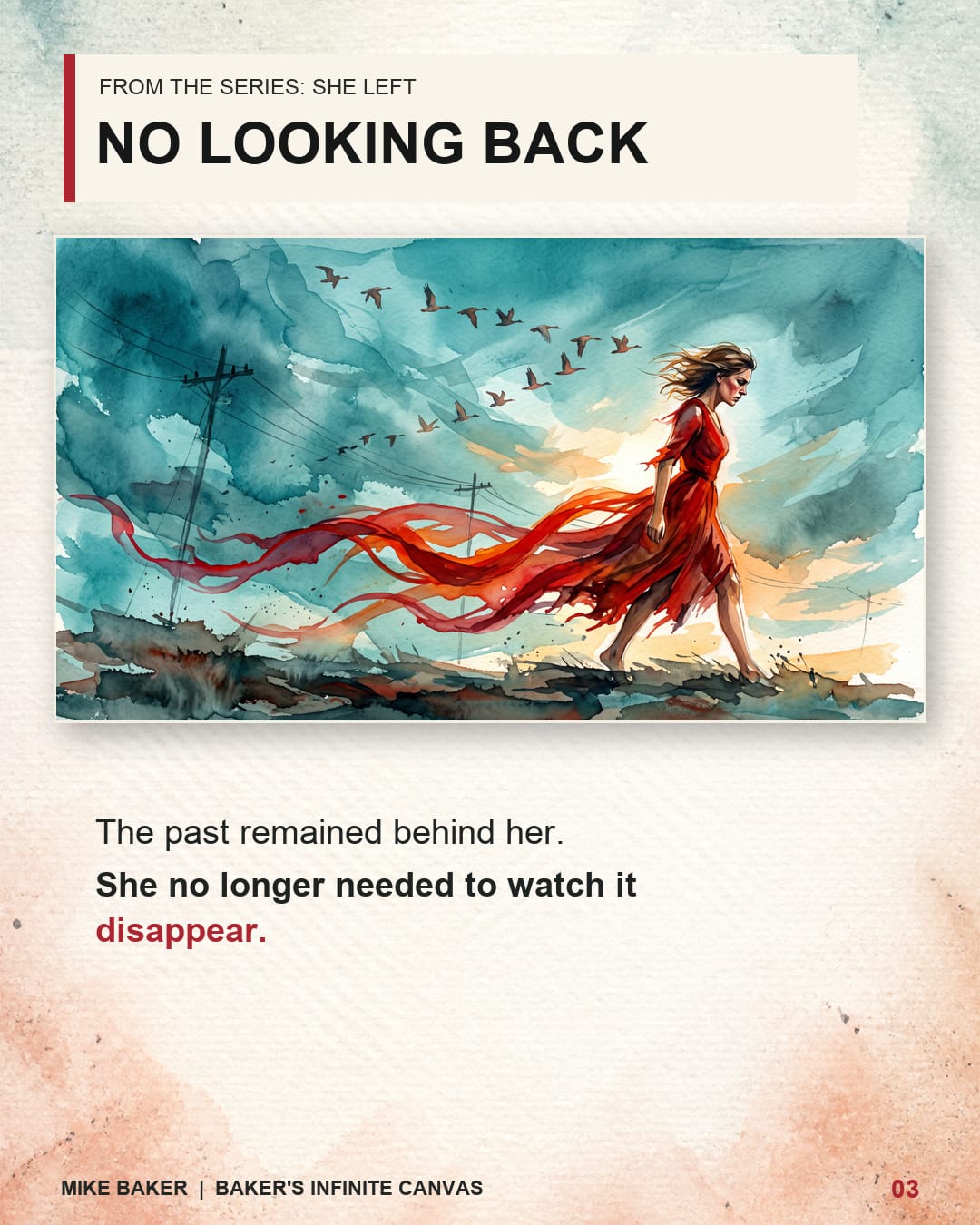
I have gone back to these three images several times since finishing them. I notice different things depending on which one I look at and what kind of day I am having. The first still has the strongest sense of decision for me. The second has become my favorite because I understand the tired part of continuing more than I used to. The third carries a kind of peace, although I am glad I did not make her look completely peaceful. She is still moving through weather. Her life did not turn into a motivational poster because she made a hard choice.
Maybe that is what I like most about the series.
She never arrives.
There is no fourth image where everything is perfect, the sky is clear, and she stands somewhere beautiful congratulating herself for completing the journey. I have lived long enough to know that life rarely gives us that kind of ending. We get farther along. Something that once consumed us takes up less room. We become more comfortable with choices that once terrified us, and eventually we notice that we went an entire day without thinking about the thing that used to occupy every hour.
Then life gives us something else to figure out.
I am okay leaving her there.
She left something she needed to leave. She kept going when going became harder. Eventually she learned to put more of her attention on where she was headed than on what was disappearing behind her. I do not need to know the rest of her story to feel like she gave me something worth keeping.
And if you look at her and see an entirely different story, I think that means the art worked.
— Mike
If this one landed
The three images are here, if you would rather look than read about looking.
The rest of the work lives at the art page.