

Believe her. Then do something useful.
Endometriosis. Perimenopause. Menopause. Different seasons, same story: a woman describing what is happening in her own body and hoping somebody takes her seriously. Any of them can turn an ordinary day, a relationship, an appointment, or an entire life upside down.
This page is practical help for the person living it, and for the father, husband, partner, friend, employer, or healthcare leader who wants to show up better.
No awareness-day slogans. No asking her to explain it one more time. Start with what you need right now.
These resources are free. Use them, print them, and send them to anyone who needs them.
She sent you here because explaining this is exhausting.
If someone you love sent you this page, pause before you defend, compare, question, or fix.
She is not asking you to become an endometriosis expert tonight. She is asking you to understand that the pain is real, the impact is bigger than a bad period, and being doubted adds another layer to something already hard.
Start here
- Believe what she tells you about her body. Pain does not have to be visible to be serious.
- Ask what would help right now. Listening, heat, food, medication, quiet, a ride, canceled plans, or simply not being alone may matter more than advice.
- Do not make her manage your reaction. She should not have to comfort you because her illness scares or frustrates you.
- Learn on your own. Caring means taking some of the burden of explanation off her shoulders.
- Keep showing up after the flare ends. Chronic illness is not over when the worst hour passes.
Say this
“I believe you.”
“You do not have to prove how bad it is to me.”
“Do you want help, company, or space?”
“What can I take off your plate today?”
“I’m going to learn more so you do not have to teach me everything.”
Not this
“Are you sure it’s that bad?”
“But you looked fine yesterday.”
“Everyone gets cramps.”
“Have you tried exercising, changing your diet, or stressing less?”
“Tell me exactly what to do.”
Suggested share text: “I’m sending this because I need you to understand what this can feel like and how to support me. Please read it before we talk.”
You do not have to solve the whole disease today.
When pain is high, even small decisions can feel like work. Make the next hour lighter.
If you are the person in pain
- Name the most urgent need: pain support, food, water, medication, warmth, rest, transportation, privacy, or medical care.
- Use one sentence if that is all you have: “I’m in a flare. I need help with ______.”
- Cancel what needs to be canceled without writing an apology essay.
- If symptoms are new, suddenly worse, or feel unsafe, contact a qualified healthcare professional or emergency service.
If you are supporting her
- Ask one clear question: “What would make the next hour easier?”
- Offer specific help: “I can bring food, handle dinner, call the clinic, drive, take notes, or sit quietly. Which one?”
- Reduce decisions. Do not hand the planning back to the person in pain.
- Protect her “no.” A canceled plan is not a personal rejection.
- Remember what helped so she does not have to rebuild the plan during every flare.
Walk in with the story organized—even if the system is not.
An appointment can move fast. Pain histories do not. These tools will not guarantee that someone listens, but they can help you make the pattern harder to miss and leave with clearer next steps.
Before
- Write down when symptoms began and how they have changed.
- Track pain, bleeding, bowel or bladder symptoms, fatigue, pain with sex, missed work or school, and anything else affecting daily life.
- List medications, treatments, tests, surgeries, side effects, and what did or did not help.
- Choose the three questions you most need answered.
- Bring a support person if you want one. Decide in advance whether they should listen, take notes, or speak up if something gets missed.
During — use direct language
“This is affecting my ability to work, sleep, study, exercise, have sex, care for my family, or live normally.”
“What conditions are you considering, and how will we evaluate them?”
“What can we do for symptom relief while the evaluation continues?”
“What are the benefits, risks, limits, and alternatives of this plan?”
“If this does not help, what is the next step and when should I follow up?”
If you feel dismissed, try
“I understand stress can affect the body. I do not want that assumption to end the evaluation. What else could explain these symptoms, and how will we rule it in or out?”
Before you leave, make sure you know
- What the working diagnosis or next question is
- What tests, referrals, or treatments were ordered
- What each treatment is intended to help
- What side effects or warning signs to watch for
- When and how follow-up will happen
- Who to contact if symptoms worsen
Love is not just feeling bad that she hurts.
Love becomes useful when it changes what you do.
During a flare
Handle the practical things you already know how to handle. Food. Kids. Pets. Calls. Rides. The plans that need to change. Do not wait to be assigned every task.
Between flares
Ask what support is working and what is not. Learn the care plan. Notice patterns without policing them. Keep intimacy, friendship, humor, and ordinary life in the relationship without pretending the illness is not there.
At an appointment
Take notes. Help preserve the timeline. Ask whether an important question was answered. Back up what you have observed, but do not take over the room or speak about her as if she is not sitting there.
When you get it wrong
Do not explain your intentions for ten minutes. Try this: “I can hear that what I said felt dismissive. I’m sorry. I believe you. What would help me respond better next time?” You do not need perfect words. You need humility, consistency, and the willingness to learn.
For the family in the waiting room
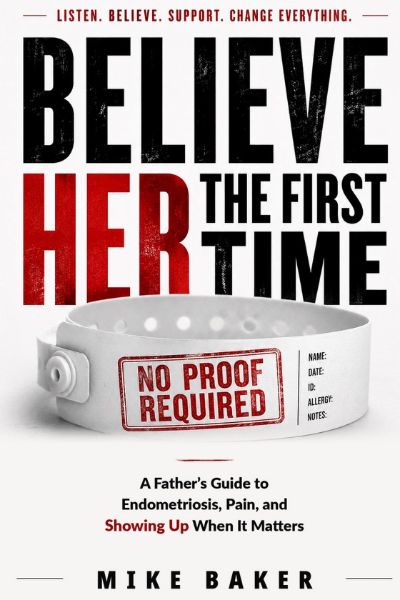
Believe Her the First Time is for the husbands, fathers, partners, and families who love someone with endometriosis and want to understand what support looks like when good intentions are not enough.
Learn about the book Get the bookBelief should not depend on which room she walks into.
I have spent years leading in healthcare. I know how hard the work is. I also know that good people inside a strained system can still create harmful experiences when pain is normalized, histories are rushed, referrals are unclear, or nobody owns the next step.
This is not about blaming a clinician. It is about building a better path.
Five questions for your next leadership meeting
- Where does the patient have to repeat her story? Map every handoff from first call to diagnosis, referral, treatment, and follow-up.
- How do we respond to chronic pelvic pain? Review triage language, clinical pathways, and what happens when common tests are inconclusive.
- What does “normal” mean in our documentation? Audit words such as anxious, dramatic, difficult, and reassured. Do they clarify care, or quietly discredit the patient?
- Who owns the next step? A referral without navigation can become another dead end. Make the plan, timing, and contact point visible.
- Are patients helping us redesign this? Include people with lived experience—and compensate them for the expertise they bring.
A 30-minute team huddle
- Read one de-identified patient story.
- Identify one moment where the patient could feel dismissed.
- Rewrite the response using plain, respectful language.
- Choose one process change the team can test this month.
- Decide how patients will tell you whether it helped.
Talks and working sessions on women’s health, belief, patient experience, and Human First healthcare leadership.
The ordinary Tuesdays matter too.
Endometriosis stories are often reduced to a diagnosis date, a surgery, or the worst day. But a life is also changed in the quieter moments: the shift missed, the dinner canceled, the heating pad at 2 a.m., the appointment replayed all the way home, the person who stayed, and the person who finally said, “I believe you.”
This work makes room for those stories.
Read the stories See the EndoDad portraits Share your story with MikeA story should never be the price of being believed. Share only what feels safe. Nothing is published without clear permission.
EndoWarriors who helped people see what pain can hide.
Before this page became a resource hub, EndoDad was already making space for people whose stories had been minimized, doubted, or carried quietly for years.
Not as inspiration content. Not as proof that someone is “strong enough.” As real people who trusted this project with part of their lives.
Take what helps. Leave the rest.
Every person and every care path is different. These are starting points—not rules and not medical advice.
Most useful right now
Send this when explaining it again feels like too much.
Organize the facts and the questions before the visit.
Capture patterns and daily-life impact.
Decide what helps before the next hard day.
Prepare for a conversation about practical support at work.
I did not begin this work because I had all the answers.
My wife, Kellie, lives with endometriosis. So does my daughter, Sammie.
I watched people I love hurt. I watched them lose pieces of ordinary life. I watched them enter rooms looking for help and leave wondering whether anyone believed them. I also had to face the ways I did not always understand soon enough or respond well enough.
EndoDad came out of that—not as my story to take over, but as my responsibility to do something with what I had seen.
So I write. I make portraits. I talk with families. I carry these stories into healthcare meetings and rooms where decisions get made. I keep saying the sentence that should not be radical:
Believe her the first time.
Then listen. Learn. Help. Change the room.
— Mike
Do one useful thing before you leave.
You do not have to fix everything today.
Send the conversation guide. Fill out the appointment sheet. Make the flare plan. Ask a better question. Change one process in your clinic. Believe someone without making her fight for it.
That is how this gets better—not all at once, but in the next conversation, the next appointment, and the next room.
Share this page Get ready for an appointment Help someone through a flare Explore every resourceThis page offers general education and practical support. It is not medical advice, diagnosis, or a substitute for care from a qualified healthcare professional. Symptoms and treatment needs vary. If symptoms are sudden, severe, new, rapidly worsening, or feel unsafe, contact a qualified healthcare professional or emergency service.
Go deeper
Three pieces you can hand someone
Written for the person standing next to her, for the days when this whole page is too much and one specific situation is happening right now.
- What to Do When She’s Having an Endometriosis Flare — a practical script for the next few hours
- What to Say When Your Wife Is in Pain and You Can’t Fix It — because most of us get this wrong before we get it right
- Women’s Health in Primary Care Needs Continuity, Not Visits — for her clinician. My op-ed in KevinMD on why one clinical home should hold the whole story
The endometriosis pages
Longer answers to the questions people actually type, written for the father, the husband, the employer, and the clinician. Every figure on them is cited by organization and date.
- A Father’s Guide to Endometriosis — start here
- How to Support Your Wife With Endometriosis — from a husband who got it wrong
- What To Do At Your Wife’s Endometriosis Appointment — the job, step by step, and the one question to ask
- My Teenage Daughter Has Painful Periods — what fathers should know
- Why Endometriosis Takes Years To Diagnose — the numbers, cited
- The Rule Changed in March. Most Clinics Have Not. — the 2026 ACOG guidance inside a primary care clinic
- Endometriosis Care Where There Is No Gynecologist — for Idaho and everywhere like it
- What Employers Should Know About Endometriosis — a CEO to other CEOs
- Believe Her The First Time — the argument behind the book
Credible places beyond this site
I am careful about where I send people. These organizations do serious work:
- Endometriosis Foundation of America — education, research funding and school outreach
- iCareBetter — a directory for finding vetted endometriosis specialists
Nothing on this page is medical advice. For diagnosis and treatment, work with a qualified healthcare professional.
A private tool
If she is the one in pain, give her this.
Everything else on this page is written for you — the partner, the parent, the friend in the waiting room. This one is not. I Believe You is hers: a private guide she opens on her own phone that turns what she is feeling into words a doctor can act on.
No account. Her answers stay in her browser and are never sent to me. There is a Quick Exit button in the corner for a reason. Send her the link and let her open it alone.
Read them here
Guides you can read without downloading anything
Every tracker and toolkit below also lives as a page on this site — open one, read it, and take what you need.
- Myth vs. Fact SheetsWhat gets repeated about endometriosis and menopause, and what the evidence actually says.
- Questions for Your Healthcare ProfessionalThe questions worth writing down before you go in.
- Doctor Appointment Preparation SheetHow to walk into an appointment ready to be believed.
- Man vs. Menopause Partner ToolkitFor partners who want to help and do not know how.
- Workplace Support PlannerWhat support at work can actually look like.
The conversation keeps moving.
Short videos and posts can reach someone on the exact night they need them. This is where the newest EndoDad portraits, practical reminders, family conversations, and advocacy work show up between longer stories.
Instagram · @endodad76
TikTok · @endodad76
Latest from TikTok · always current
Latest on YouTube · always current
Follow @endodad76 on TikTokSocial platforms may collect data when their feeds load. Use the profile links above if you would rather view the posts on Instagram or TikTok.