
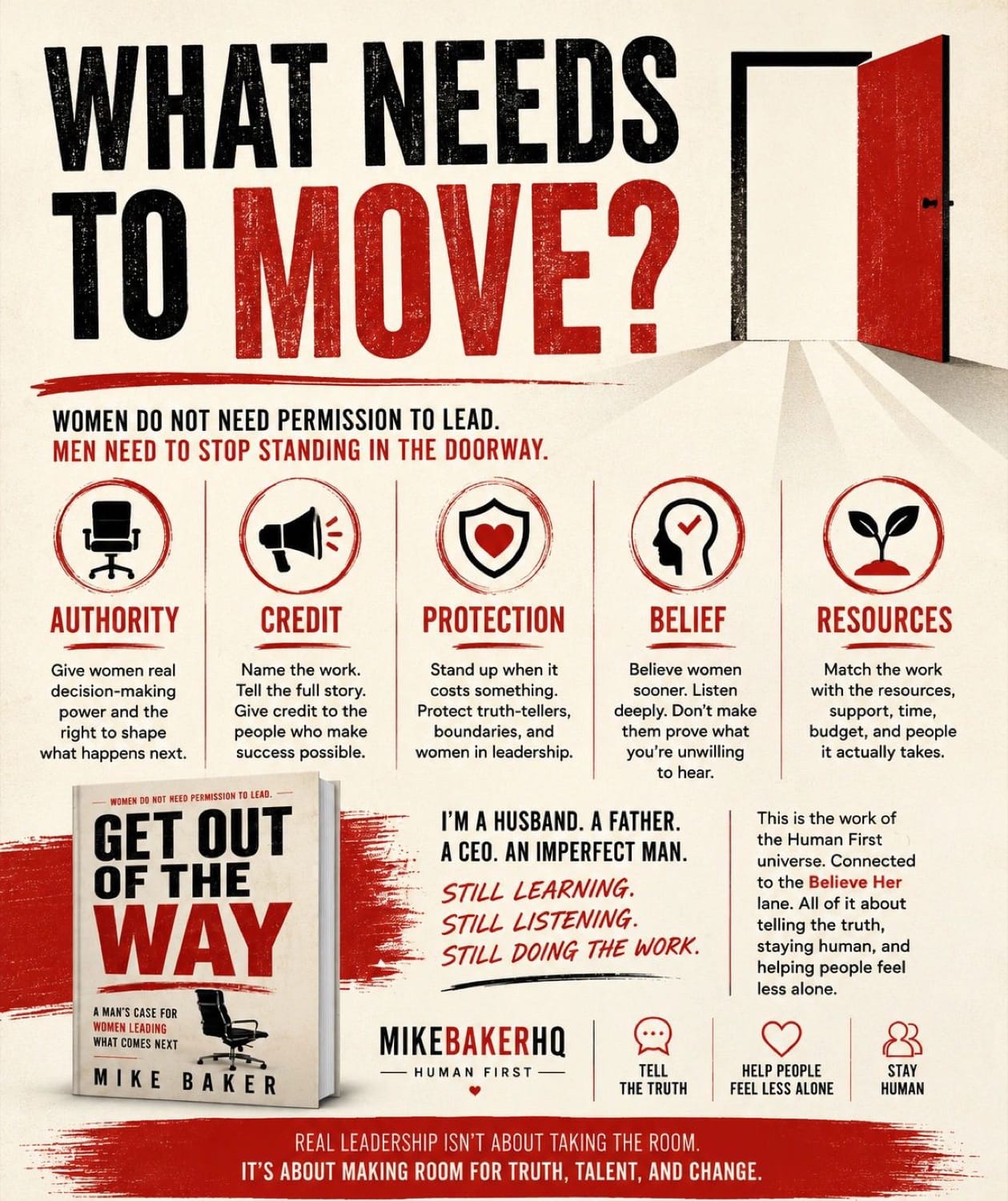
What Needs to Move for Women’s Leadership? Authority, Credit, Protection, Belief, and Resources
Women do not need permission to lead. Men need to stop standing in the doorway.
That is the heart of Get Out of the Way: A Man’s Case for Women Leading What Comes Next. I write that as a man, a husband, a father, a CEO, and an imperfect leader who still has plenty to learn. I have spent much of my adult life in rooms where men were trusted faster, forgiven more easily, and imagined forward with less proof. I have benefited from that. I have also missed things I should have seen sooner.
That is the uncomfortable part of this conversation for men like me. It is easier to talk about the obvious examples: the loud sexist, the cruel boss, the abusive man, the politician who mistakes domination for strength, or the leader who cannot handle being challenged by a woman. Those men have done real damage, and they should be named clearly. But the harder conversation includes decent men too. Men who love their wives, believe in their daughters, respect women at work, and still benefit from rooms that were built around male authority before we ever walked into them.
I am not writing this because I have figured everything out. I have not. I still hold power. I still carry a title. I still move too fast sometimes. I still have to watch the way my ego wants to defend my intent before I have fully understood my impact. I still have to ask whether my support for women has become practical enough to matter. I still have to look at my home, my leadership, my organization, my history, and my habits with more honesty than comfort prefers.
That is why the conversation about women’s leadership cannot stop at support. Support is easy to say, especially for men who know how to sound decent in public. We can talk about the strong women in our lives, the daughters we believe in, the wives we admire, the mothers who shaped us, and the colleagues we respect. Some of that respect is sincere, and sincerity matters. But sincerity does not move authority by itself. It does not move money. It does not move protection. It does not move credit. It does not change who gets trusted when the room gets hard.
The better question is practical: what needs to move? If we say we believe in women’s leadership, then authority has to move. Credit has to move. Protection has to move. Belief has to move. Resources have to move. Otherwise, we are just admiring women from the comfort of rooms still arranged around men.
Authority Has to Move
A lot of women have had influence without authority for a long time. Influence can matter. It can shape decisions, help a room see what it was missing, and keep a bad idea from becoming worse. But influence without authority still depends on someone else deciding whether to listen. It asks women to persuade the person with the title, the budget, the final vote, the platform, or the ability to say yes.
I have had to examine this in my own leadership. As a CEO, I hold formal authority whether I feel humble about it or not. The title walks into the room before I do. I can say I value women’s leadership, but the real question is whether authority, decision rights, resources, credit, and protection move toward the women who have earned trust and are already carrying the work. Admiration is not enough from the most comfortable seat in the room.
A woman can be invited into the conversation and still not have power. She can be asked for input and still be excluded from the decision. She can be trusted with the emotional labor, the operational detail, the staff concern, the patient experience, the cultural cleanup, and the human consequence of the work, while someone else holds the authority to decide what happens next. A room can sound inclusive while still keeping the final say in the same familiar hands.
If women are close enough to the work to understand the truth, they should be close enough to power to change the outcome. Authority moving does not mean standards disappear. It does not mean titles get handed out carelessly. It means organizations, families, boards, churches, and communities need to examine whether women have been carrying responsibility without the actual decision rights to match.
The questions are not complicated, but they are revealing. Who gets the final say? Who controls the budget? Who can change the plan? Who can stop harm before it spreads? Who gets trusted before every question has been answered? Who is asked to carry the work while someone else keeps the authority? Those questions matter because authority is where admiration either becomes real or gets exposed as performance.
This is one of the reasons Get Out of the Way belongs inside the Believe Her lane of MikeBakerHQ. Believing women is not only about believing women’s pain, though that matters deeply. It is also about believing women’s judgment, leadership, warnings, competence, and authority before the room has exhausted them with proof.
Credit Has to Move
Credit is one of the quiet currencies of power. It shapes reputation, opportunity, promotion, visibility, and who gets imagined forward. It influences who receives the next invitation, the next platform, the next chance to lead, and the next benefit of the doubt.
Women have too often watched their work become someone else’s visibility. They brought the warning, and someone else repeated it later and got called strategic. They built the process, and someone else presented the result. They held the relationship, protected the trust, managed the details, and made the outcome possible. Then the room applauded the person who looked most comfortable explaining it.
I have had to learn to listen for this in the rooms I lead. Who actually built the thing? Who carried the history? Who protected the relationship? Who knew where the plan would break? Who held the staff concern before it became visible to leadership? Who made the outcome possible before someone else presented it? Those are not small questions. They reveal whether credit is traveling toward the actual work or toward the most familiar version of authority.
This kind of credit theft is not always dramatic. Sometimes it happens through habit. Sometimes people genuinely do not see the chain of work behind the final moment. Sometimes leaders praise the person at the microphone because the invisible labor underneath the outcome stayed invisible. But credit that does not travel accurately eventually changes who gets power.
If the same people keep getting named and the same people keep making the outcome possible in the background, the system is teaching everyone whose work counts. Women do not need vague praise for being amazing. They need accurate credit for what they built, carried, solved, led, repaired, and changed. Men can help by naming women’s work clearly in the room, refusing to let women’s ideas become more credible only after a man repeats them, and making sure the story of success includes the people who actually made success possible.
Credit is not a small courtesy. It is part of how authority grows. When credit keeps moving toward men, opportunity usually follows. When credit moves honestly, leadership becomes easier to see.
This is true in workplaces, healthcare, families, advocacy, and creative life. It is also one of the connective threads between Get Out of the Way, Believe Her the First Time, Man vs. Menopause, and The Better Man Field Guide. The books are different doors into the same Human First work: telling the truth, staying human, and helping people carry less alone.
Protection Has to Move
Protection tells the truth about power. It is easy to support women when the room is already clapping. The harder test comes when a woman tells the truth, makes an unpopular decision, challenges a powerful person, names a pattern, sets a boundary, or leads in a way that makes the old room uncomfortable.
That is when support has to become protection. A woman should not have to stand alone after saying what everyone else was afraid to say. She should not have to absorb retaliation, gossip, tone policing, isolation, or reputation damage while the men who privately agree stay quiet in public. Too many men have mastered private support and public silence. That combination helps old power survive.
This is one place where men have to be painfully honest. I have been in rooms where it would have been easier to stay quiet. I have had moments where I knew the right thing to do but still felt the pull of comfort, politics, timing, or conflict avoidance. That does not make me unique. It makes me a man inside systems that often reward quiet agreement more than honest protection. The point is not to confess and then feel better. The point is to change what happens next.
Protection does not mean shielding anyone from accountability. Women are human. Women can lead well or poorly, make strong decisions or weak ones, build trust or damage it. Protection means fair treatment when women exercise authority. It means a woman’s hard decision is not treated as evidence that she is difficult while a man’s hard decision gets called leadership. It means truth-tellers are not punished for telling the truth. It means organizations do not protect comfort over reality.
Men with power need to ask who their silence protects. Silence is not neutral when power is uneven. If a woman is being undermined and men stay quiet because speaking up would be awkward, the silence protects the undermining. If a woman names harm and leaders worry more about the reputation of the person she named than the cost of what she carried, protection is already moving in the wrong direction.
This is where men’s responsibility becomes more than language. A man can believe women should lead and still fail the test when leadership makes the room uncomfortable. A man can admire women and still leave them exposed. A man can say all the right things in private and still help the old room survive by staying quiet when his voice would cost him something.
Belief Has to Move
Being believed quickly is a form of power. Many men have had that power for so long we do not recognize it. We say something feels wrong, and the room leans in. We say someone is not ready, and the room considers it. We say a situation feels off, and people trust our read. We make a mistake, and people imagine growth. We speak with confidence, and the room hears readiness.
Women have often had to bring more proof for the same level of seriousness. They have had to document the obvious, soften the truth, manage tone, and wait for someone else to confirm what they already knew. In healthcare, this has shown up in the long delay too many women experience before their pain is believed. In workplaces, it shows up when women name patterns and are asked whether they are reading too much into the situation. In families, it shows up when women carry invisible labor and then have to prove the load is real.
This is personal for me because women’s pain has shaped my life as a husband and father. Watching my wife and daughter live with endometriosis changed the way I hear women when they say something is wrong. It made belief feel less like a concept and more like care. It made delay feel less like process and more like another weight someone in pain has to carry. I wish I had understood that earlier with the depth I understand it now.
Belief does not mean abandoning fairness or process. It means refusing to start from suspicion just because the truth arrived from a woman. It means treating women as credible narrators of their own experience while facts are understood. It means asking what she may have seen that others missed. It means listening before defending the room, the man, the tradition, or the institution.
That lesson belongs in leadership too. If women keep telling us something is wrong in the room, our first job is to listen seriously enough that action becomes possible. Men need to practice slowing down our defenses and speeding up our attention. That is true in healthcare, at work, in families, in faith spaces, and anywhere women have had to repeat the truth until someone with more power finally decided it was real.
That is why Get Out of the Way connects naturally to Believe Her the First Time. One book focuses on endometriosis, women’s pain, and what men need to understand when the healthcare system or the people around a woman do not believe her soon enough. The other widens the lens to leadership, power, workplaces, families, and institutions. The same human failure shows up in different rooms: women tell the truth, and power takes too long to believe them.
Resources Have to Move
Power often reveals itself through resources. Budgets, staffing, time, authority, technology, training, pay, space, support, and access all tell the truth about what an organization actually values. A room can say women’s leadership matters, but if women are expected to lead without resources, the statement is thin.
Women have been asked to do too much with too little for too long. They have been asked to hold culture without staff, manage change without authority, support people without relief, solve problems without budget, and create trust inside systems that do not give them enough structural backing. That burns people out while allowing leaders to praise their strength.
As a CEO, I have to sit with that. Mission-driven work can make people carry more than they should because the work matters so much. Healthcare especially can do this. People keep showing up because patients need them. Women often carry culture, trust, detail, memory, care, and emotional consequence because the mission needs someone to hold it all together. A leader can admire that and still fail the people carrying it if admiration never becomes resources.
Resources moving means the work women carry gets matched with the support required to do it well. It means women are paid fairly, staffed appropriately, given decision rights, and included early enough to shape the work before the plan hardens. It means women’s leadership is not treated as a symbolic win while the conditions around them remain impossible. It also means men stop acting generous when they finally share what should never have been hoarded in the first place.
If we want women’s leadership to thrive, we have to stop giving women responsibility without the practical tools to carry it. A title without resources can become another trap. Public praise without backing can leave a woman exposed. A seat at the table without decision rights can turn into theater. The work has to be resourced because real leadership always has material conditions.
This applies in companies, nonprofits, healthcare organizations, churches, schools, families, and community movements. It applies wherever women are trusted to carry the load but not given enough power to change the system creating the load.
The Room Has to Change
This is the heart of Get Out of the Way: A Man’s Case for Women Leading What Comes Next. Women do not need permission to lead. Men need to stop standing in the doorway. That means more than saying supportive things. It means looking honestly at the rooms we have shaped and asking whether anything real has moved.
I say that as someone still inside the question. I am not writing this from outside power. I am not writing this as a man who has arrived at some enlightened place and now gets to lecture everyone else. I still have power. I still hold a title. I still have influence in rooms before I always understand how that influence is landing. I have made mistakes. I have moved too fast. I have defended my intent too quickly. I have missed impact. I have had to apologize. I am still learning how to become more useful and less centered.
That is exactly why men need this conversation. We do not have to be villains to have work to do. We do not have to hate women to benefit from systems that trusted us faster. We do not have to be cruel to miss invisible labor. We do not have to be bad men to need correction. The future needs men mature enough to hold those truths without collapsing into defensiveness or turning guilt into another way to stay at the center.
The old room often gave men authority before women received belief. It gave men credit before women received recognition. It protected men’s reputations before women’s truth. It gave men resources while asking women to be grateful for influence. That old room has cost us too much. It has cost women time, health, opportunity, money, peace, and trust. It has cost organizations better decisions. It has cost families honesty. It has cost boys a fuller version of manhood.
The next room has to be built differently. Authority should follow demonstrated wisdom, not old familiarity. Credit should travel to the people who made the work possible. Protection should move toward truth-tellers, not only toward people with status. Belief should arrive early enough to matter. Resources should match the responsibility people are already carrying.
Men who care about women’s leadership need to ask better questions. Where am I still standing in the doorway? Where do I support women in theory while holding power in practice? Where do I privately agree but publicly stay quiet? Where have I praised women’s strength while leaving the load in place? Where has my comfort mattered more than her authority?
The answers may be uncomfortable. Good. Comfort has protected too much for too long.
How This Fits the Human First Universe
MikeBakerHQ is built around a simple center: tell the truth, stay human, and help people feel less alone. The books, music, podcast, advocacy, essays, and art all move through different parts of that same work. Get Out of the Way belongs in that universe because it asks men to tell the truth about power without making women carry the emotional cost of our learning.
It sits beside Believe Her the First Time, which asks men to believe women’s pain and understand endometriosis with more urgency and humility. It connects to Man vs. Menopause, which asks husbands and partners to show up better during perimenopause and menopause. It connects to The Better Man Field Guide, which asks men to practice repair, responsibility, and emotional maturity. It connects to the broader Human First work because leadership without humanity eventually becomes performance, and performance has already cost women too much.
The books are different, but the thread is the same. Believe women sooner. Listen better. Move closer to responsibility. Stop making people prove pain, competence, exhaustion, or leadership longer than they should have to. Build rooms where people can be fully human and still have authority.
If this message matters to you, read Get Out of the Way: A Man’s Case for Women Leading What Comes Next. Share it with a man, leader, team, board, book club, or organization that needs the conversation. If you read it and it helps, please leave an honest Amazon review. Reviews help independent books reach more of the people and rooms that need them.
The future does not need more men collecting better language about women’s leadership while the room stays the same. It needs men willing to move something real: authority, credit, protection, belief, and resources. Start there, and the conversation stops being performance. Start there, and leadership begins to look more like the truth.
Keep Reading
Read Get Out of the Way: A Man’s Case for Women Leading What Comes Next https://a.co/d/0dPIXgTv
Explore all of Mike Baker’s books on Amazon https://amazon.com/author/mikebakerhq
Visit MikeBakerHQ https://www.mikebakerhq.com
Related books in the Human First universe:
Believe Her the First Time: A Man’s Guide to Endometriosis https://www.amazon.com/dp/B0FDJDR59X
Man vs. Menopause: A Husband’s Guide to Perimenopause and How Not to Mess This Up https://www.amazon.com/dp/B0FDJD8ZWP
The Better Man Field Guide https://www.amazon.com/dp/B0FDJFBZCJ