
By Mike Baker
People ask about AI all the time now. They ask artists. They ask writers. They ask musicians. They ask podcasters. They ask people making images, songs, books, essays, speeches, websites, videos, and anything else that used to feel easier to categorize.
Sometimes the question is honest curiosity. Someone wants to know what tools I use, how the process works, where the human part begins, and where the machine part ends. I like that conversation. I think we need more of it, especially now that AI creative tools are becoming part of writing, music, art, healthcare, education, leadership, and daily work.
But sometimes the question does not feel curious. Sometimes when someone asks, “Did you use AI?” I hear something underneath it. I hear the suspicion that I cheated, stole, faked the work, or somehow proved I do not have any real talent.
Maybe they do not always mean it that way. Sometimes I know they do. Either way, it lands in a tender place because the work is not fake to me.
The books are not fake. The songs are not fake. The art is not fake. The essays are not fake. The podcast is not fake. The advocacy is not fake.
The tools are part of the process, but the life behind the work is mine.
Why this question lands so hard
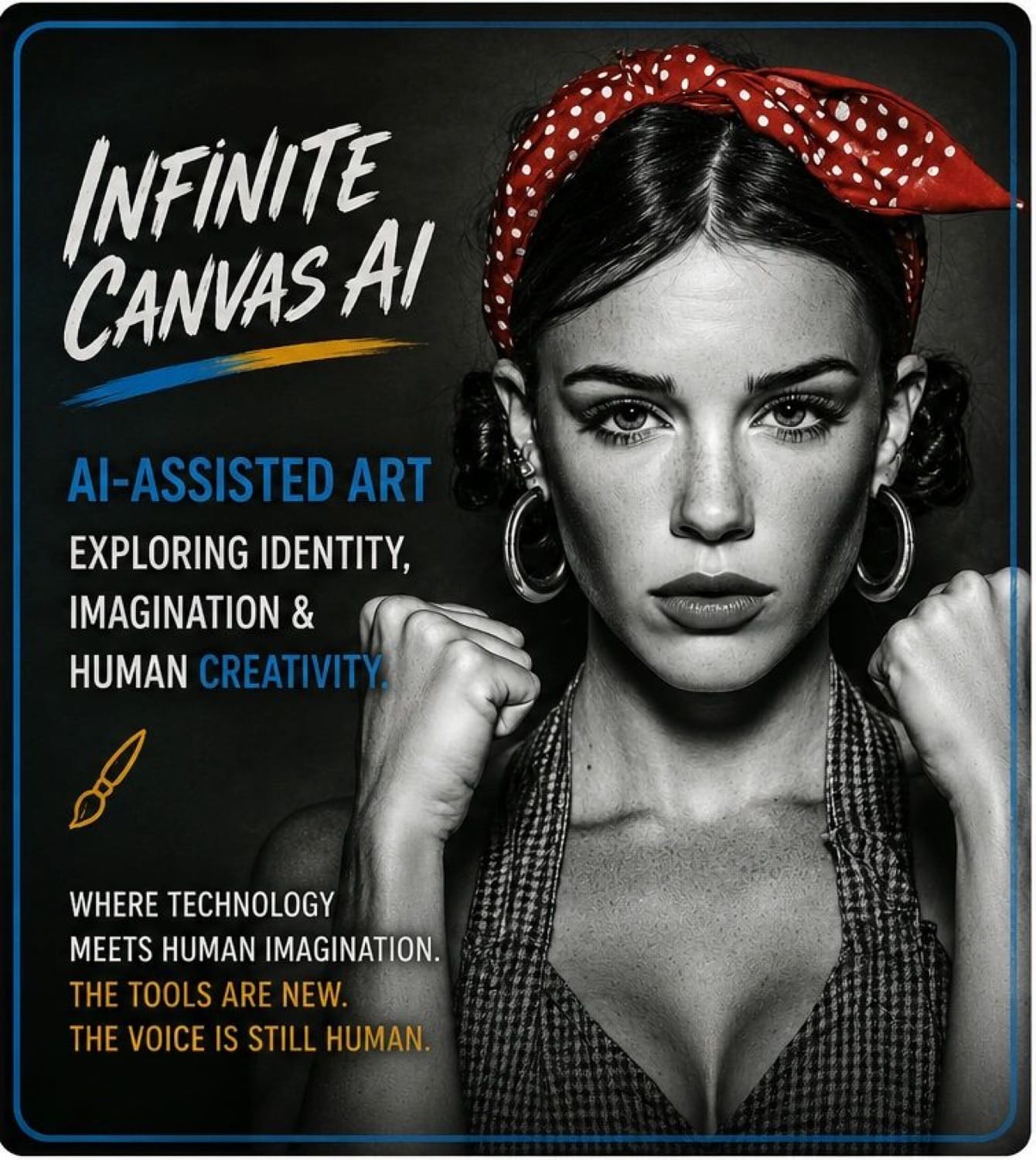
MikeBakerHQ exists because I have a lot I am trying to say across a lot of forms. Some of it becomes a Human First book. Some of it becomes a song through Mike Baker Music. Some of it becomes a piece of AI-assisted artwork through Infinite Canvas AI. Some of it becomes an episode of Still Here Still Trying. Some of it becomes EndoDad advocacy, a blog post, a speech, or a conversation with someone who is carrying more than people can see.
AI helps me move faster from feeling to form. It helps me organize, draft, test, revise, sketch, and build. It helps me work with the speed of my ADHD brain instead of losing half the ideas before I can catch them.
But AI does not hand me a life I did not live.
It does not give me a wife and daughter with endometriosis. It does not sit with me in grief. It does not lead Heritage Health through hard decisions in North Idaho. It does not leave a faith tradition and try to stay whole. It does not write from the ache of Alzheimer’s, the pressure of leadership, the fear of a hospital update, or the stubborn hope that keeps showing up when life is heavy.
That is the human part. That is the part I refuse to let anyone erase.
The skepticism is fair. The assumption is not.
I understand why people are skeptical. I am skeptical too.
AI can be used badly. It can flatten voice, imitate people, scrape work, flood the internet with low-effort content, and make it harder to know what is real. Those concerns are not small. Anyone using AI in creative work should take them seriously.
But there is a difference between asking a real question and assuming the worst.
When someone treats AI use as automatic dishonesty, they ignore the part of creation that happens before the tool ever opens. They ignore lived experience. They ignore judgment. They ignore taste, restraint, revision, memory, care, and responsibility. They ignore the years of work, pain, love, leadership, family, and advocacy that shape what a person is trying to make.
I am not offended by the question itself. I am worn down by the assumption that using a new tool means the work has no soul.
That is not how I experience it.
The work comes from real life
When I write about endometriosis, I am writing from my family’s life. When I write as EndoDad, I am writing from the helplessness and love of watching people I care about fight to be believed. When I make AI-assisted art through Infinite Canvas AI, the images are tied to women’s health, grief, identity, advocacy, and the stories too many people carry without being seen.
When I wrote Believe Her the First Time, I was not asking AI to invent pain. I was trying to turn lived pain into something that might help another dad listen sooner, another husband believe faster, another family support better.
When I write Man vs. Menopause, I am trying to help men stop making an already hard part of life harder for the women they love. When I write Still Here, Still Trying, I am writing from the honest place of being tired and still not done. When I write Still My Mom, I am writing about Alzheimer’s, love, loss, and the grief that starts before goodbye.
When I write Beautifully Unfocused, I am writing about ADHD from the inside. When I write The Future Still Needs Us, I am writing about AI itself and the question that keeps pressing on me: what kind of future are we building, and who gets protected inside it?
Those books are connected because the work is connected. The music, the podcast, the art, the essays, and the speaking are connected too. They all come from the same place: real stories, human voice, and the work of staying connected through real life.
AI is a tool. It is not the author of my life.
AI can help me find a structure. It can help me test language. It can help me make a visual draft. It can help me revise a paragraph, explore a lyric, shape a podcast description, or move from a rough emotional mess into something I can share.
But AI is not the author of my life.
It did not walk through faith transition. It did not build Heritage Health. It did not bury my mom. It did not hold my family through endometriosis. It did not learn the hard way that optimism without honesty does not help anyone. It did not feel the shame, speed, creativity, and pressure of ADHD. It did not stand in front of a team during hard seasons and try to lead with steadiness.
The tool can help make the work. It cannot become the reason the work matters.
That is why I use the phrase Human First. It is not decoration for me. It is the standard I am trying to hold myself to. Human First means the person matters more than the platform. The story matters more than the tool. The responsibility stays with the creator. If I put my name on something, I am responsible for it.
That includes the books. It includes the songs. It includes the artwork. It includes the podcast. It includes every part of MikeBakerHQ.
The music and writing are part of this too
People tend to focus on AI art first because it is visible. They look at an image and want to know how it was made. That makes sense.
But the same question is now following writing and music too.
Did you use AI to write that song? Did you use AI to shape that book? Did AI help with the cover, the description, the post, the episode, the idea?
Sometimes the honest answer is yes. AI helped somewhere in the process.
But help is not replacement.
Mike Baker Music comes from the same story engine as the books. The songs are about grief, family, faith, hope, ADHD, love, community, and staying human in a loud world. AI may help me explore a lyric, a structure, a style, a demo, or a production path, but the emotional source is still human. The reason I make the song is still human. The line I keep or cut still comes down to whether it feels true.
I do not want to flood the world with content. I want to make work that carries something.
Some of it will be imperfect. Some of it will be experimental. Some of it will be shaped with tools people are still learning how to trust. I would rather be honest about that than pretend I am creating from some untouched, pure, old-world process that does not exist for most modern creators anyway.
Writers use editors. Musicians use production tools. Photographers use software. Designers use templates. Filmmakers use effects. AI makes the question louder, and it should. But louder does not mean simpler.
Public conversation is part of the responsibility
Some of my work has drawn public conversation. Some people have concerns about AI-assisted art. Some people are uneasy about how AI is changing creative work. Some people worry about ownership, consent, labor, and whether human artists are being pushed aside.
Those concerns deserve respect.
I do not want to answer them with defensiveness. I want to answer them with clarity.
I use AI openly. I use it as a creative tool. I do not use it to replace lived experience, fake expertise, steal someone else’s story, or pretend the work came from nowhere. The work is rooted in my life, my family, my healthcare leadership, my advocacy, my grief, my questions, my faith transition, my ADHD, and my creative point of view.
That does not mean everyone has to like it. It does not mean every use of AI is good. It does not mean I will always get it right. I am still learning. We all are.
But I know the difference between a shortcut and a tool. I know the difference between imitation and expression. I know the difference between content made to fill space and work made because something inside you will not leave you alone.
I am trying to make the second kind.
Why I keep making the work
I keep making this work because I believe stories can move people closer to care.
A book can help a husband understand perimenopause differently. A post can help a dad believe his daughter sooner. A song can give someone language for grief. A podcast conversation can make someone feel less alone. A piece of art can help someone see pain they had been trained to ignore. A speech can help a team slow down and remember why the work matters.
That is the point.
The point is not to prove I used the fewest tools possible. The point is to make something useful, honest, and human with the tools available to me.
I understand that some people will still ask the AI question with suspicion. That is part of creating right now. I can live with the question. I can even learn from it. But I will not accept the idea that using AI means there is no talent, no heart, no craft, no risk, no story, and no responsibility.
That is too easy.
The harder truth is that we are entering a creative world where people will need to judge the work with more care. We will need better questions. Who made this? Why did they make it? What lived experience is behind it? Are they transparent about the process? Does the work help, exploit, flatten, or reveal? Does it point back to a human being who is willing to stand behind it?
I am willing to stand behind mine.
That is the work behind Infinite Canvas AI. It is the work behind Mike Baker Music. It is the work behind Still Here Still Trying. It is the work behind EndoDad. It is the work behind the Human First books. It is the work behind MikeBakerHQ.
AI may be part of the process. The voice is still human.
If this one landed
One-Thirty in the Morning is the same question at one in the morning, when I am the one using the tools instead of writing about them.
If you want the book length version, Human First is where most of this thinking ended up.