Why this book exists
We have more ways to reach one another than any generation before us, yet many people feel less heard, less known, and less connected. The devices are faster. The opinions are louder. The human being across the table can still disappear behind a role, a label, a chart, a mistake, or a screen.
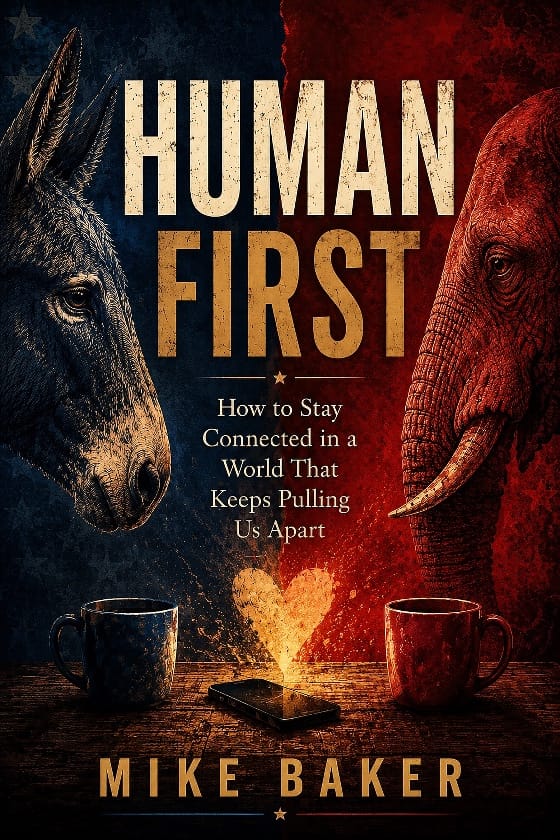
Human First begins with a simple conviction: before someone is an employee, patient, parent, partner, political opponent, customer, creator, or problem to solve, they are a person. They arrive with a full life we cannot see—history, fear, dignity, pressure, love, grief, and needs that do not fit neatly inside the moment in front of us.
That conviction is not softness without limits. Seeing the person does not require ignoring danger, excusing harm, surrendering a boundary, or abandoning accountability. It asks us to tell the truth without contempt and to build safety without forgetting anyone’s humanity—including our own.
The closest relationships make the test practical. Love cannot remain a private feeling or a good intention. It becomes behavior through attention, tone, follow-through, shared work, honest apologies, and the small choices that tell another person they are not receiving whatever the rest of the day left behind.
When we miss one another, intent matters—but impact still lands. Repair begins when we become curious about that impact, resist the reflex to defend ourselves, and make an apology credible through changed behavior. Relationships breathe when truth and responsibility can occupy the same room.
Power raises the responsibility. Leaders, parents, clinicians, institutions, and systems shape what other people are allowed to say, risk, need, and become. A title can make a room quieter without the person holding it realizing what has been lost. Human-first leadership pays attention to whose truth is missing.
Healthcare and work reveal the cost of forgetting. Patients are people before they are charts. Employees are people before they are output. Caregivers and clinicians are people before they are endlessly available. Humane systems still need standards and results; they simply refuse to achieve them by making people smaller.
The future makes this work more urgent. The internet trains us to react to fragments. Artificial intelligence can amplify speed, creativity, access, and connection, but it should serve human judgment rather than replace human presence. The central question stays wonderfully ordinary: What does this do to the relationship?
Human First exists because the world will keep giving us reasons to reduce one another. This book is an invitation to practice the return—to the person before the label, the relationship beneath the argument, and the small choices that help people find their way back to one another.
The text matters. The tone matters. The apology matters. The person matters.
Who it's for
This book is for spouses, parents, friends, leaders, clinicians, caregivers, educators, creators, community builders, and anyone tired of living inside outrage, defensiveness, loneliness, or shallow connection. It is for people who want practical ways to protect dignity, use power responsibly, repair what they can, and stay human in difficult rooms.
Who it's not for
This book is not a demand to reconcile with unsafe people, tolerate abuse, abandon a boundary, avoid conflict, or make empathy do the work of accountability. It does not replace medical, mental-health, legal, financial, workplace, or safety advice. It offers stories, questions, and practices for readers to use with judgment and appropriate professional support.
Questions it answers
- How did constant connection leave so many people feeling less known?
- What changes when we see the person before the label?
- How does love become behavior in the relationships closest to us?
- Why do the people we love sometimes receive what is left of our attention?
- How can parents love their children without trying to control them?
- What makes an apology strong enough to let a relationship breathe again?
- How should power change the way leaders listen, decide, and respond?
- How can healthcare and workplace systems serve people without losing standards?
- How can we disagree honestly without turning one another into enemies?
- How should the internet and AI strengthen connection rather than replace it?
Inside
Part One, How We Lost Each Other, examines the noisy world around us: shrinking attention, defensive habits, disgust in place of disagreement, and the ease with which the person across the table becomes a category instead of a human being.
Part Two, The Relationships Closest to Us, brings the idea home. The chapters explore practical love, the leftovers of our attention, parenting without control, adult friendship and loneliness, and apology as the work that lets damaged relationships breathe.
Part Three, Human First at Work and in Community, looks at leadership and power, patients before charts, humane workplaces, and the ordinary rooms where community is either weakened or rebuilt. It asks institutions to measure success without losing sight of the people carrying the system.
Part Four, Relationships in the Future We Are Building, turns toward the internet, artificial intelligence, hard disagreement, the small things that hold people together, and the choices that can help us find our way back to one another.
A final word, reflection questions, and The Human First Manifesto turn the argument into a personal practice: protect dignity, keep boundaries, notice power, repair impact, and let technology make more room for human voice—not less.
Before you start
This book discusses loneliness, anxiety, depression, ADHD, trauma, grief, bullying, substance use and addiction, self-harm risk, dangerous or abusive relationships, discrimination, racism and sexism, political and religious conflict, medical dismissal, illness and healthcare strain, burnout, workplace power, online cruelty, and dehumanization. It also references endometriosis, menopause, Alzheimer’s loss, and family grief. Some names, details, and circumstances are changed or blended for privacy. The book is personal reflection, not medical, mental-health, legal, financial, or professional advice; urgent health or safety concerns belong with qualified professionals.
A note from me
I wrote this as a husband, father, healthcare leader, creator, and person who has watched good people miss one another in rooms where everyone believed they were trying. I have been the person who listened well, and I have been the person whose defensiveness made listening almost impossible.
The lesson is less glamorous than a grand theory. The person in front of us has to remain a person. That is true at the kitchen table, in a waiting room, during a leadership decision, in a family text thread, and in the moment an argument tries to turn someone we love into a problem we need to defeat.
Human first does not mean comfort first. Boundaries matter. Safety matters. Accountability matters. Sometimes the most respectful answer is a clear no, a consequence, a report, professional help, or distance. The practice is holding those truths without using them as permission to become cruel.
I also believe the tools we build should help us become more human. My creative philosophy is simple: AI Tools. Human Voice. Technology can help us think, organize, translate, and make—but it should create more room for judgment, relationship, imagination, and responsibility, not less.
I am not writing as someone who has mastered connection. I am writing as someone who keeps needing the practice. Notice the whole person. Ask what this choice does to the relationship. Tell the truth. Repair the impact. Make love visible. Then do it again in the next ordinary room.
A note on names and scope
Some names, identifying details, and circumstances in this book were changed or blended to protect people’s privacy. What happened, and what it meant, is unchanged.
It is also not medical, mental-health, legal, or financial advice. It is one person’s account of what it takes to keep treating people like people.
306 pages · Published 30 June 2026 · Mike Baker HQ · With Jacob Baker
Read chapter one free
The World Got Loud and We Got Smaller
Chapter one of Human First is free to read right here on the page. No download, no card, nothing to install. Sign up with your email and the chapter opens on this page. It also puts you on Just an Ordinary Tuesday, my newsletter, and you can leave that anytime.
You’re signed in, so chapter one is open below. Tap the page or use the arrows to turn.
Continue reading
- The Future Still Needs Us. Explores the responsibility to build technology and institutions that protect human dignity and leave a livable future behind.
- Better Man Field Guide. Turns good intentions into practical responsibility, listening, repair, and behavior the people closest to us can feel.
- Believe Her the First Time. Carries the human-first commitment into advocacy, healthcare, institutional response, and the choice to believe women before harm compounds.
Print it, fill it in by hand, keep it somewhere you will actually see it.
The Person Before the PositionThe Listening AgreementThe System-to-Person CheckThe Middle PracticeThe Human-First Decision Download the workbook (PDF) →
Companion work
Human First — the album
I wrote an album alongside this book, out of the same material. Fourteen songs, same title.
Go to the album →