Why this book exists
Some days do not need a transformation plan. They need one real sentence, a glass of water, a smaller next step, and permission to stop treating exhaustion like a character flaw. Life is already loud enough without turning one hard Tuesday into evidence that your entire existence needs a rebrand.
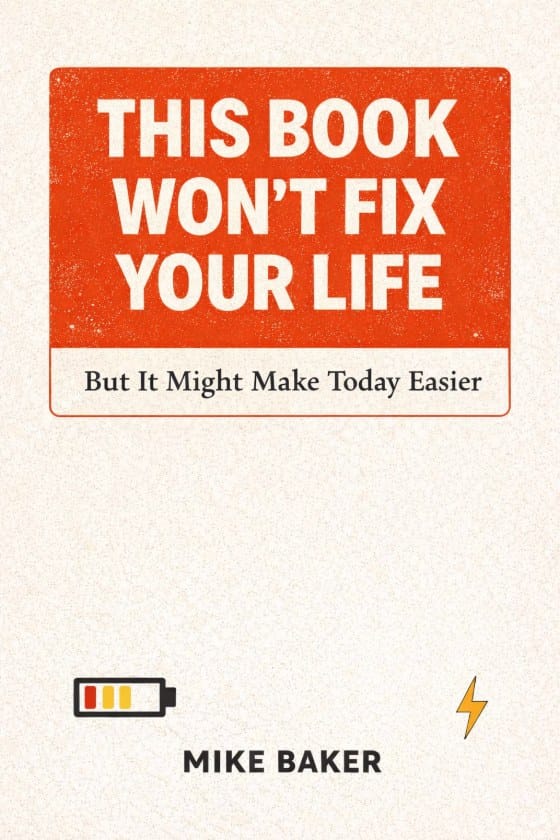
This Book Won’t Fix Your Life was written for that kind of day. The chapters are short on purpose. They meet readers in the car, in the shower argument with themselves, at two in the morning when the brain becomes an unreliable narrator, and in the stretch of afternoon where a to-do list starts feeling weirdly personal.
The book does not promise a perfect morning routine, a brand-new personality, or a clean line from struggle to healing. It makes room for overwhelm, burnout, anxiety, ADHD, self-doubt, grief, dysregulation, ambition, and the stubborn wish to believe something good might still be possible.
Humor matters here because life can be heavy without every page becoming another heavy thing to carry. The cussing, strange metaphors, Peach Monster references, and honest detours are not decorations. They create breathing room while the book tells the truth about what it costs to keep functioning when your capacity is gone.
The first movement is permission: you do not need a life plan today. You are allowed to be at capacity. Not every thought deserves authority. Not every problem needs an immediate meltdown. Good enough is not a moral failure when your standards are demanding more energy than your actual life has available.
The second movement is trust. Thoughts can be weather instead of warnings. Healing can arrive quietly. Your wiring is not a character flaw. Support, tools, and medication do not make a person weak. You can learn to hear yourself without letting the loudest inner voice become the only narrator.
Then the book turns toward hope without forcing certainty. Hope can feel suspicious after life has hurt. It can sit beside grief and exhaustion without pretending they disappeared. Sometimes hope is only an appointment, a returned text, one honest breath, or enough openness to admit the future may contain more than survival.
The final sections ask what becomes possible when readers stop introducing themselves only through what hurt them. Building a life that fits is not one cinematic leap. It is permission becoming momentum, old expectations losing authority, honest work being shown, and the next brave choice becoming small enough to do.
This book exists to offer company rather than a cure. It cannot fix a life, and it does not pretend to. It can give language, loosen shame, make someone laugh in a hard room, and help today feel a little more livable. Sometimes that is not small at all.
You’ve carried more than most people know. You’re still here. That matters more than you think.
Who it's for
This book is for overthinkers, emotionally exhausted people, ADHD brains, burned-out helpers, hopeful-but-suspicious readers, creators who are afraid to show the work, and anyone who keeps showing up while running on fumes. It is for readers who want short, candid company instead of a lecture or a polished performance of healing.
Who it's not for
This book is not clinical treatment, crisis support, diagnosis, or a promise that perspective can solve illness, danger, or serious mental-health concerns. It is not for readers who want profanity-free inspiration, rigid productivity systems, or certainty dressed up as hope. Professional health and safety needs still deserve qualified care.
Questions it answers
- What if today needs a smaller next step instead of a complete life plan?
- How can I tell the difference between falling apart and reaching capacity?
- Why does my to-do list feel like evidence that I am failing?
- What do I do when my brain turns one strange moment into a full documentary?
- Can a thought be weather instead of a warning I have to obey?
- What does good enough look like when my standards are higher than my energy?
- How can hope help without pretending everything is fine?
- What if healing is happening quietly enough that I almost miss it?
- How do I stop treating ADHD or different wiring like a character flaw?
- How do I begin building a life that feels true rather than merely expected?
Inside
Section One, For Days When You’re Overwhelmed AF, makes room for capacity, feelings, breaking points, invisible load, and the radical possibility that today does not require a five-year plan.
Section Two, For Days When You Are Tired of Your Own Bullshit, loosens perfectionism, overprocessing, impossible standards, and the pressure to turn every difficult moment into a full personal transformation.
Section Three, For Days When Your Brain Won’t Shut the Hell Up, deals with spiraling thoughts, the inner critic, two-in-the-morning narratives, and the freedom that begins when awareness stops being mistaken for complete healing.
Section Four, For Days When You Need Hope but Don’t Trust It Yet, offers a form of hope that does not lie. It asks for willingness, one more step, defiant joy, and openness to good that cannot yet be seen.
Sections Five and Six move from self-trust to construction: ADHD and support, dysregulation, quiet healing, permission, momentum, discipline, confidence, creative courage, and building a life that fits the person actually living it.
Sections Seven and Eight move beyond survival toward identity, courage, leaving what no longer fits, and remembering the reader has not run out of chances. Stories, poems, and the afterword offer no grand fix—only language, company, and a way back toward today.
Before you start
This book uses frequent profanity and candid humor. It discusses overwhelm, burnout, anxiety, panic and spiraling thoughts, ADHD, dysregulation, grief and loss, shame, self-criticism, emotional exhaustion, difficult days, survival, uncertain hope, changing identity, medication and other forms of support, healthcare appointments, and hospital settings. It does not directly discuss suicide or self-harm. Some names and identifying details were changed to protect privacy. The book offers personal stories and reflection, not clinical treatment, diagnosis, crisis support, or professional advice.
A note from me
I did not write this because I have life figured out. I wrote it as an ADHD-riddled, anxious, hopeful, stubborn-as-hell human who has broken down, rebuilt, overthought the rebuild, and still wakes up trying to choose the gritty version of optimism.
People sometimes see the leader, creator, storyteller, husband, or dad and assume the internal meeting must be going smoothly. It is not. My brain can turn a text, a comment, a hard day, or a quiet room into a full documentary with panic directing and exhaustion handling production.
What helps is rarely a dramatic revelation. It is usually smaller: one next step, one song, one honest conversation, one appointment, one friend who pulls me out of my own head, or enough humor to stop confusing the loud thought with the whole truth.
I believe support counts. Tools count. Medication can count. Rest counts. Showing the work while you are scared counts. Hope that still feels suspicious counts. You do not earn care by becoming easy, productive, perfectly regulated, or inspirational about whatever hurt.
If these pages help, I hope they help like good company. I hope they make you laugh, give a feeling a name, and help you stop declaring war on yourself before noon. The book will not fix your life. Neither will this workbook. But maybe one honest sentence can make today easier, and maybe today is enough to work with.
A note on names
Some names and identifying details in this book were changed to protect people’s privacy.
132 pages · Published 31 July 2026 · Still Here, Still Trying Press, Coeur d'Alene, Idaho
Read section one free
For Days When You’re Overwhelmed AF
Section one of This Book Won't Fix Your Life is free to read right here on the page. No download, no card, nothing to install. Sign up with your email and the chapter opens on this page. It also puts you on Just an Ordinary Tuesday, my newsletter, and you can leave that anytime.
You’re signed in, so section one is open below. Tap the page or use the arrows to turn.
Continue reading
- Still Here, Still Trying. Carries the same honest hope into family, leadership, grief, creativity, repair, and the ordinary acts of care that keep a life moving.
- Beautifully Unfocused. Goes deeper into ADHD, too many open tabs, creative intensity, shame, support, and learning to work with the brain you actually have.
- The Optimist’s Way. Explores the practical choice to keep hope without pretending life is easy or asking pain to become inspirational.
Print it, fill it in by hand, keep it somewhere you will actually see it.
The Fix-It FantasyThe Life I Actually HaveThe Shame InterruptionThe Boring PlanThe Unfixed Life Download the workbook (PDF) →