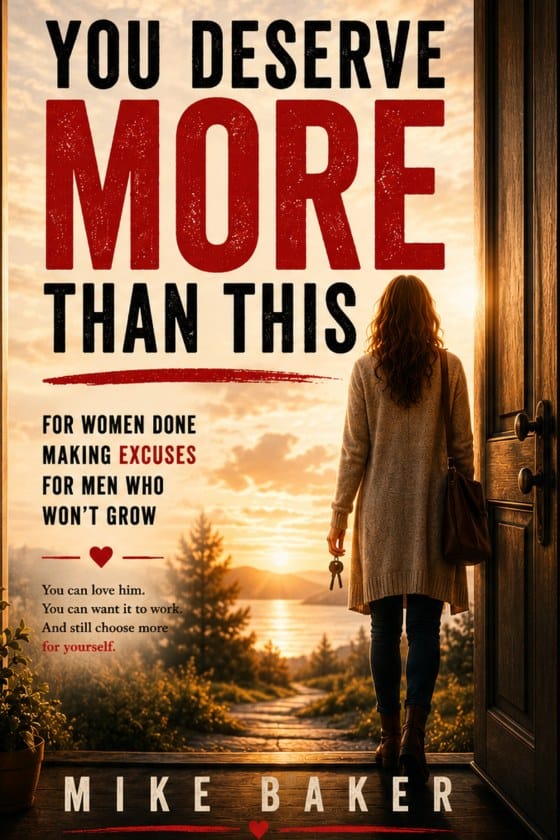
Why this book exists
Women are often asked to keep honoring a man’s intentions while living with the consequences of his behavior. They are told to communicate better, be more patient, forgive faster, lower the standard, remember his potential, and explain his pain back to him while their own life keeps getting smaller.
You Deserve More Than This exists to interrupt that bargain. It is for the moment when apologies keep arriving but change does not, when hope has become a full-time job, and when a woman is spending more energy editing the truth than the man beside her is spending on growth.
Mike Baker writes as a husband, father, friend, healthcare leader, and man who believes women have already explained their lives clearly enough. The point is not for a man to speak over women or tell them what their experience means. The point is to name what too many men and institutions still excuse.
The book distinguishes flawed, immature, unavailable, harmful, and dangerous behavior because the wrong advice in the wrong relationship can cause harm. A flawed and accountable partner may be able to repair. A dangerous man does not need a better conversation. Safety, trained support, and a careful plan come first.
That distinction changes the questions. Is he growing, or are you carrying the relationship for both of you? Does he respect a no when it costs him something? Can you tell the truth without managing his reaction? Does his apology produce sustained behavior, or only enough relief to restart the cycle?
The book examines charm, potential, weaponized incompetence, emotional management, sexual pressure, money and control, digital monitoring, apologies without change, and the exhausting version of a man a woman has to edit before she can describe him to people she loves.
It also gives the body and the pattern a place in the evidence. Fear matters. Relief when he leaves the room matters. The shrinking life matters. The friend who notices matters. A woman does not need courtroom-level proof before she is allowed to trust what repeated experience has been telling her.
Raising the standard is not about demanding perfection. It is about honesty, consistency, responsibility, tenderness, consent, shared labor, respect for boundaries, and accountability that becomes visible without a woman having to manage it. Chemistry is not character, and potential is not present-tense partnership.
Some relationships need repair. Some need firm boundaries. Some need distance. Some need to end. This book does not make that decision for the reader. It offers language, practical tests, safety-first guidance, and support for the next honest step—because a woman’s dignity and future matter in every version of the answer.
Love should not require you to disappear.
Who it's for
This book is for women who feel confused, depleted, lonely, controlled, dismissed, sexually pressured, financially trapped, responsible for a man’s emotions, or exhausted by promises that do not become change. It is also for friends, family members, advocates, and accountable men who want clearer language for patterns, safety, boundaries, and growth.
Who it's not for
This book is not therapy, legal advice, medical care, crisis response, or a substitute for a domestic-violence or sexual-assault advocate. It does not tell a reader to confront a dangerous person, announce a boundary, or leave without support. If a partner monitors devices, money, movement, or communication, even reading or storing material may require a safer device and trained guidance.
Questions it answers
- Am I asking too much, or have I been trained to accept too little?
- Is he growing, or am I carrying the relationship for both of us?
- What is the difference between an apology and accountability?
- Does he respect my no when respecting it costs him something?
- Am I in a flawed, immature, unavailable, harmful, or dangerous relationship?
- What are the pattern, body, friend, no, and evidence tests showing me?
- How do money, sex, digital access, children, pets, and faith become tools of control?
- What does safe love feel like in behavior rather than promises?
- How can I set boundaries without making his reaction my responsibility?
- What is the next honest step if clarity, support, distance, or safety planning is needed?
Inside
Part One, How Women Get Talked Out of Themselves, names the early training, the pressure to be the cool girl, the safety math women do, and the quiet process of distrusting one’s own needs and body.
Part Two, The Asshole Pattern, examines charm without character, potential instead of evidence, apologies without change, emotional management, weaponized incompetence, sexual pressure, financial control, and digital red flags.
Part Three separates flawed, immature, unavailable, harmful, and dangerous men. The distinction matters because growth, boundaries, distance, and safety planning are not interchangeable responses.
Part Four offers five practical tests: the no test, pattern test, body test, friend test, and evidence test. Together they move the reader from isolated incidents and explanations toward the shape of the lived relationship.
Parts Five and Six define accountability, safe love, boundaries, green flags, leaving without requiring hatred, telling someone the whole truth, dating again, and building a life that does not require disappearing.
The back matter includes safety and support resources, a relationship assessment, evidence log, boundary builder, next-honest-step plan, and guidance for the moments when the fog comes back.
A note from me
I am not a therapist, domestic-violence expert, or relationship guru. I am a husband, father, friend, healthcare leader, and man who has listened to women I love describe the edited version first and the fuller truth later. Too often, the fuller truth revealed a pattern everyone had been trained to soften.
I am not writing because women need a man to explain their own lives back to them. Women have been naming emotional labor, coercion, fear, sexual pressure, dismissal, control, and the quiet ways they disappear inside painful relationships for a very long time. Too many people—especially men—have refused to listen.
I also know men can grow because I have had to grow. A long marriage taught me that intention is not enough. Love has to become humility, restraint, shared work, honest listening, repair, and changed behavior. A man does not earn endless access to a woman’s life because he can describe why he hurt her.
Some imperfect men are safe and accountable. Some men keep using charm, pain, shame, therapy language, faith, sex, money, or apology to preserve the arrangement. Dangerous men require a different response entirely. I never want a chapter, worksheet, or hopeful sentence to push a woman toward a confrontation that makes her less safe.
My hope is that this book feels like a friend outside the fog saying: I believe you. The pattern matters. Your body matters. His response to your no matters. You do not need to hate him before you protect your life. You are allowed to expect honesty, consistency, responsibility, tenderness, and change you do not have to manage.
Before you start
The people and situations in this book are illustrative composites, not real individuals.
It is also not a substitute for professional medical, psychological, or legal advice, and reading it does not create any professional relationship. If you are in immediate danger, call emergency services. In the United States you can reach the National Domestic Violence Hotline at 1-800-799-7233, or text START to 88788.
522 pages · Published 1 August 2026
Read chapter one free
You Are Not Asking Too Much
Chapter one of You Deserve More Than This is free to read right here on the page. No download, no card, nothing to install. Sign up with your email and the chapter opens on this page. It also puts you on Just an Ordinary Tuesday, my newsletter, and you can leave that anytime.
You’re signed in, so chapter one is open below. Tap the page or use the arrows to turn.
Continue reading
- Believe Her the First Time. Carries the same commitment into women’s health, medical dismissal, endometriosis, advocacy, and believing pain before harm compounds.
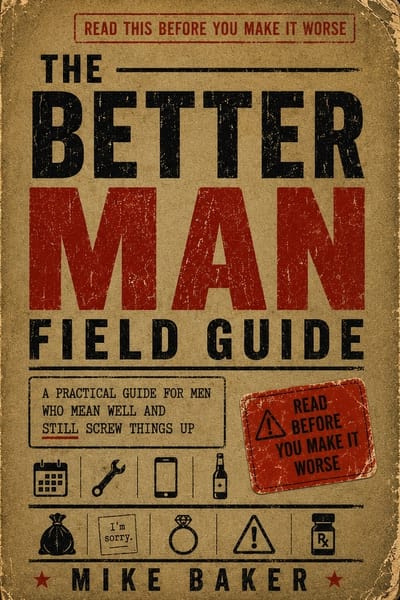
- Better Man Field Guide. Asks men to turn intention into accountability, listening, shared responsibility, repair, consent, and behavior the people closest to them can feel.
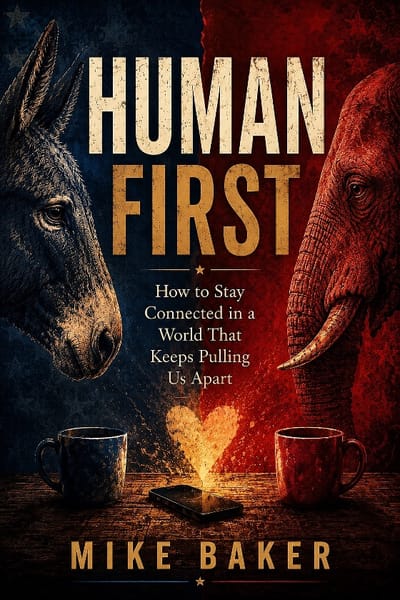
- Human First. Explores dignity, power, hard conversations, boundaries, humane systems, and the practice of seeing a whole person without excusing harm.
Print it, fill it in by hand, keep it somewhere you will actually see it.
The Pattern LogThe Body TestThe Boundary BuilderTell Someone the Whole TruthThe Next Honest Step Download the workbook (PDF) →