
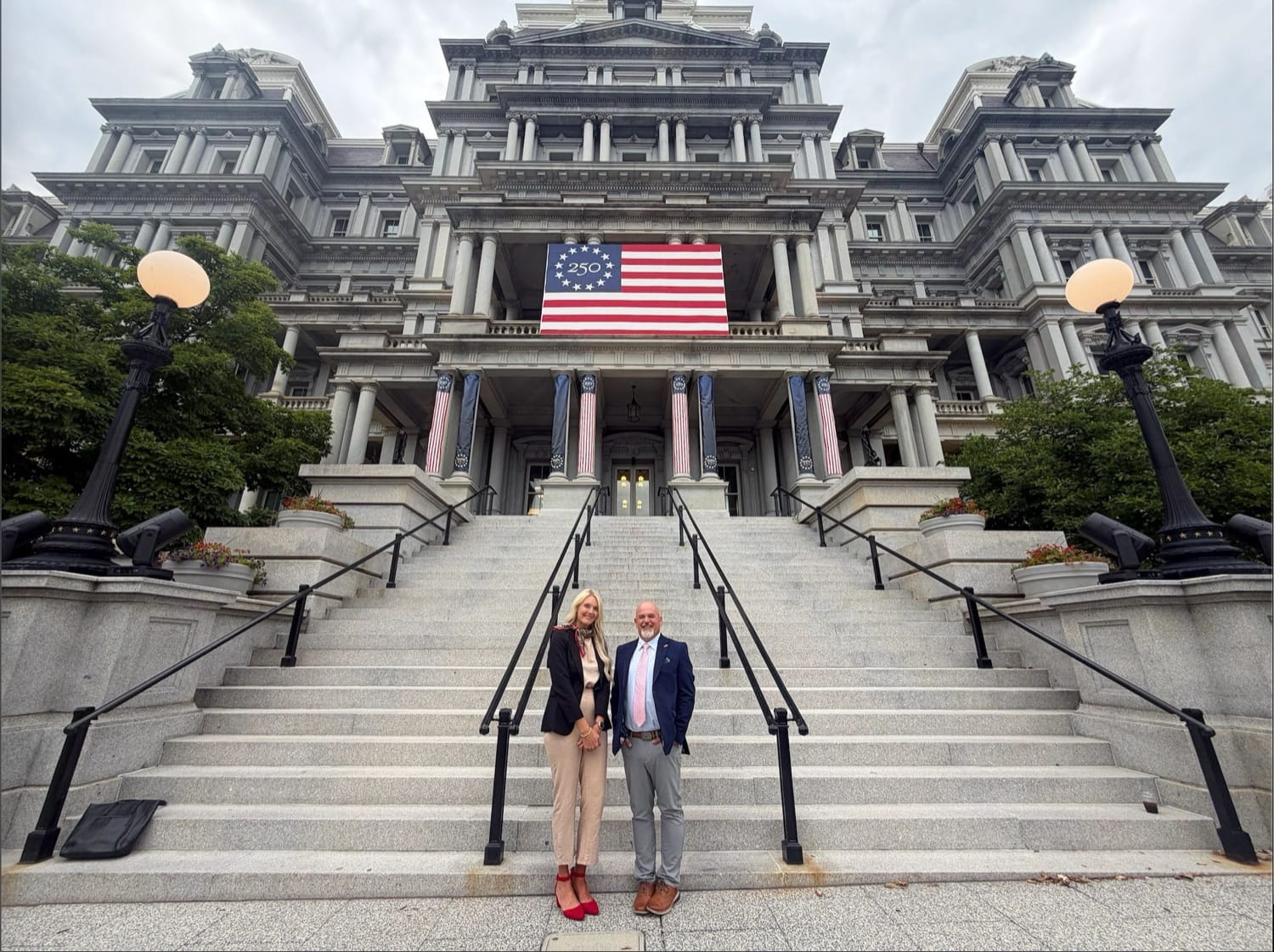
I just spent a week in Washington, D.C., in rooms full of people who believe American healthcare can be worthy of the people it serves — clinicians, advocates, and community health center leaders who spend their lives proving it. Somewhere between a rooftop at the Watergate Hotel and the back seat of an Uber, they helped me figure out what all of my work has been about.
It’s three-thirty in the morning and I’m sitting on the floor beside an open suitcase, drinking a monster I have no business drinking, because every time I close my eyes another conversation from this week comes back to me. I know how memory works. If I don’t write this down tonight, the details will fade, and with them the feeling that something important shifted.
I spent the past week in Washington, D.C., at the Association of Clinicians for the Underserved conference, representing Heritage Health. I went in expecting the usual rhythm of these trips — come home with a notebook full of ideas, people to call, policies worth watching. And I have all of that. But the biggest thing I brought home won’t fit inside a notebook.
Sometime during the second day, I realized I couldn’t stop talking about women’s health. Nobody planned that, least of all me. Someone would ask about Heritage Health, and within a few minutes we’d be deep into endometriosis, or perimenopause, or behavioral health, or what it would look like if community health centers became the best place in America for a woman to receive care. It happened in meeting rooms and hallways, over dinner, on the rooftop of the Watergate Hotel, and in the back seat of an Uber after the driver asked the question every visitor to that city gets: “So what brings you to Washington?”
What struck me wasn’t that I cared so much about the topic — I already knew that. What struck me was that I never reached for statistics first. I reached for stories. I told people about Kellie. I told them about Sammie. I talked about women who spent years looking for answers while being told nothing was wrong, that the pain would eventually pass, that they were probably just anxious. Those stories carried more weight than any slide deck ever could, because they belonged to real people with faces and families.
I never reached for statistics first. I reached for stories.
Then something happened that I didn’t expect: nearly every person I spoke with answered by telling me about someone they loved. A physician described patients who had spent years trying to be believed. A health center CEO talked about his daughter. Someone else mentioned a sister, and another man quietly shared what his wife had been living with for years. One conversation became another, and somewhere in there we stopped talking about healthcare as an industry and started talking about the people waiting for it to do better. I don’t think that’s an accident. That’s where the work has always started.
Later that evening I stood on the Watergate’s rooftop and watched the sun settle behind the monuments. Washington is a city where history feels close enough to touch — you spend the day walking past buildings where enormous decisions get made, then sit down to dinner with people whose lives are devoted to helping someone get through tomorrow. I kept thinking about trust, maybe because the hotel itself carries the weight of one of the country’s great failures of it, and yet all week I’d been surrounded by people whose work depends on earning trust one conversation at a time. The longer I stood there, the more I realized the same thing was happening inside me.
For years I’ve kept my life in separate categories. Heritage Health was my leadership work. Mike Baker HQ was where I wrote books, made art, released music, and chased ideas that mattered to me. Endometriosis advocacy grew out of watching people I love navigate a healthcare system that too often asks women to prove their pain before it believes them. Somewhere between those conversations in Washington, I understood that I’d been drawing lines that never actually existed. Every book I’ve written has been about paying attention to people. Every piece of art I’ve shared has been an attempt to tell a story words couldn’t quite reach. Every decision I’ve made at Heritage Health comes back to the same question: how do we create a place where another human being feels seen, respected, and cared for?
It’s all the same work.
That realization may be the most valuable thing I carried home.
There were lighter moments, too. I somehow got swept up in the Whova leaderboard competition and discovered I’m more competitive than I like to admit. I watched my friend and colleague Allisha Rutherford represent Heritage Health with a confidence and authenticity that made me incredibly proud. I spent time with Amanda Pears Kelly, who has one of those rare gifts for noticing the person standing quietly at the edge of the room and making sure they become part of the conversation. Those moments matter, because leadership isn’t measured only in presentations and titles. It’s measured in relationships.
Tomorrow morning I’ll unpack the suitcase, answer a week’s worth of email, and settle back into the familiar rhythm of work. On the surface, life will look exactly the way it did before I left. But the trip didn’t give me a new mission — it gave me a clearer view of the one that’s been there all along. At Heritage Health, that means continuing to build a place where every patient feels heard, and where women’s health finally receives the attention it has deserved for far too long. At Mike Baker HQ, it means continuing to write about the things that make us more human, because stories have a way of opening doors that arguments never will.
People sometimes ask me where the hope in healthcare is. After this week, I can answer with certainty: it’s in the rooms where people still tell each other stories about the ones they love, and then get up the next morning and go build something better for them.
The conversations I had in Washington are over. The work they pointed toward is only beginning.
Mike Baker leads Heritage Health and writes at Mike Baker HQ, where books, art, music, and advocacy all circle the same question: how do we build places where people feel seen? He writes often about women’s health and endometriosis.
If this one landed
I wrote Women Should Not Have to Lose a Decade Before We Believe Them on the way to that same conference. It is the argument I carried into those rooms.
And if the person you love is the one you kept thinking about while reading this, Still My Mom is the long version of that.