
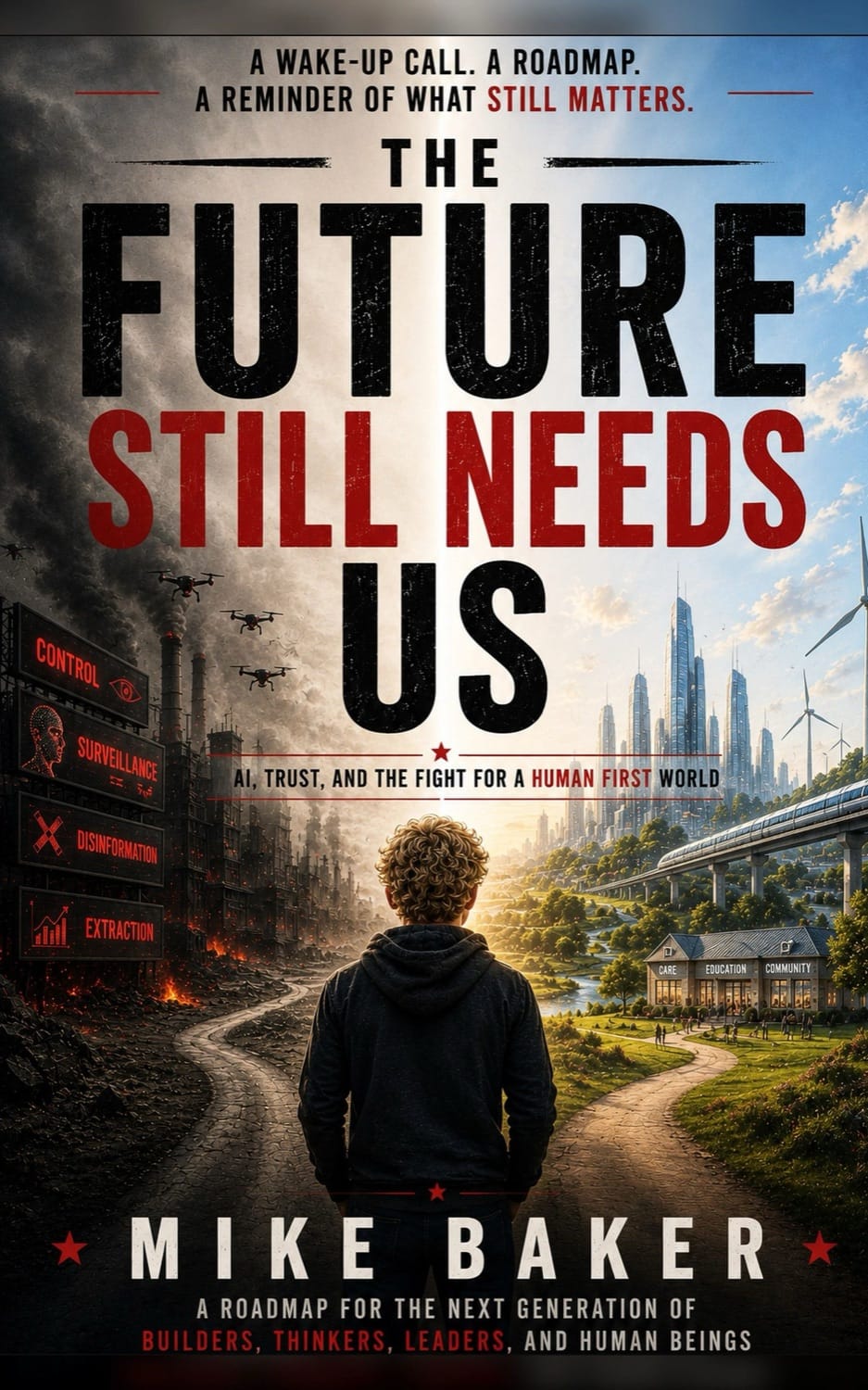
AI is already changing the world. The question is no longer whether it is coming. The question is what kind of people we are going to become while it is here.
That is why I wrote The Future Still Needs Us.
This book is about AI, creativity, healthcare, community, power, trust, and the human responsibility we still have in the middle of rapid change. I am not anti-AI. I use it every day. I create with it. I think with it. I have seen how powerful these tools can be when they help people imagine, build, write, organize, and solve problems faster than before.
I also believe we need to stop acting like the future can be safely handed over to tools, platforms, billionaires, algorithms, or whatever company has the loudest product launch this week.
The future still needs us because technology does not carry a conscience on its own. People do.
Why this book matters
A lot of the AI conversation gets stuck in two bad places. One side treats AI like magic that will fix everything. The other side treats it like a monster that will destroy everything. Both reactions miss the human work in front of us.
AI will change jobs, schools, healthcare, creativity, business, politics, relationships, and the way people understand truth. It will create opportunities. It will create harm. It will make some work easier and some problems harder. It will amplify human imagination, but it will also amplify greed, bias, surveillance, disinformation, laziness, and whatever else people decide to pour into it.
That is why the conversation cannot only be technical. It has to be moral. It has to be human.
We need people asking better questions. Who benefits? Who gets left behind? Who controls the tools? Who owns the data? What happens to trust? What happens to creativity? What happens to care? What happens to people who already live on the edges of systems that were not built with them in mind?
Those are not side questions. They are the questions.
Who this book is for
The Future Still Needs Us is for people trying to understand AI without losing their humanity. It is for creators wondering what these tools mean for their work. It is for leaders trying to make decisions before the rules are clear. It is for healthcare people thinking about access, trust, and care. It is for parents watching their kids grow up in a world that will feel different from the one we knew.
It is also for people who feel both fascinated and uneasy. That is a reasonable place to be. You can be curious about AI and still have concerns. You can use the tools and still question the systems behind them. You can believe in innovation and still care about human dignity.
This book gives people a way to stay engaged without becoming either naive or cynical.
The human part still matters
The future will not be shaped only by code. It will be shaped by values, incentives, policies, communities, families, leaders, artists, teachers, clinicians, builders, and ordinary people deciding what they will accept and what they will refuse.
AI can generate words. It can generate images. It can summarize, predict, sort, recommend, imitate, and accelerate. But it does not know what it means to hold someone’s hand in a clinic room. It does not know what grief costs. It does not know why a song matters to one person and not another. It does not understand love, duty, tenderness, regret, courage, or the quiet work of caring for someone when nobody is watching.
Those things still belong to us.
That is why I keep coming back to the same belief: the tools are powerful, but the human part has to stay in charge.
Why I wrote it
I wrote this book because I use AI and still have questions. I believe in the promise and still see the danger. I can feel the creative possibility, and I can also feel the risk of people surrendering too much too quickly because the tools feel impressive.
I do not want us to sleepwalk into the future. I want us awake, honest, thoughtful, and brave enough to build something better than the worst timeline.
This book came from that tension. It came from hope, concern, curiosity, and the belief that the future is still something we have a responsibility to shape.
A book for right now
If you are trying to make sense of AI, this book is a good place to start. If you are a creator, leader, parent, healthcare worker, student, teacher, or person wondering what kind of future we are walking into, The Future Still Needs Us was written for you.
The goal is not to panic. The goal is not to worship the tools. The goal is to stay human enough to ask what kind of world we are building and who we are becoming while we build it.
The Future Still Needs Us is available now on Amazon.
You can also browse all of my books here: