
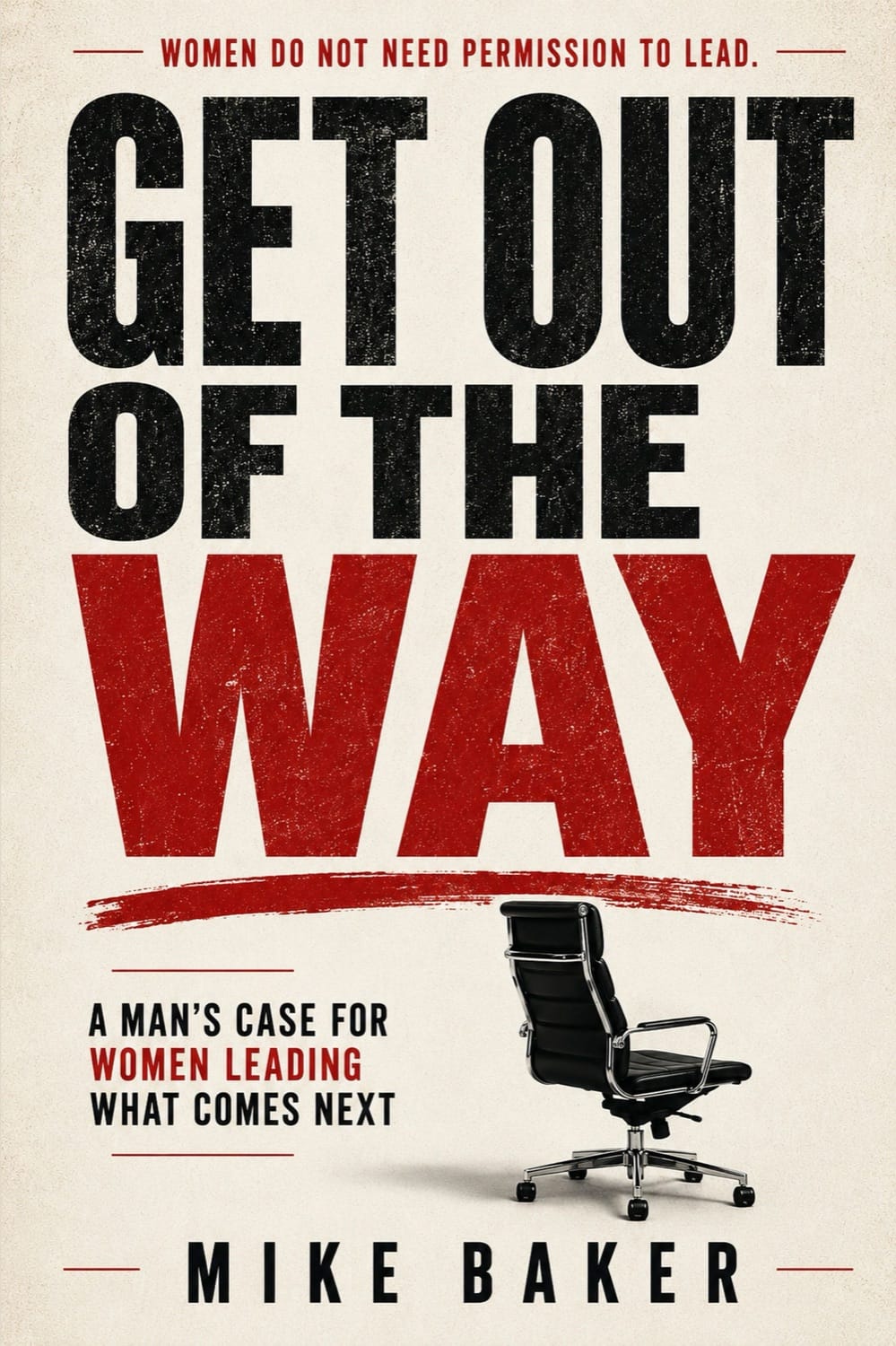
I wrote Get Out of the Way: A Man’s Case for Women Leading What Comes Next because the women in my life have shaped almost everything good in me, and the longer I have lived, loved, parented, and led, the harder it has become to ignore how often women have carried the work while waiting for the authority, credit, protection, belief, and resources that should have been there from the beginning.
This book comes from a personal place. It starts with my mom, who was a nurse. I grew up watching her do work that asked for her mind, her feet, her patience, her compassion, and her strength. Nursing is skilled work, physical work, emotional work, technical work, and human work all at once. My mom understood care in the real world. She understood that people need you when you are tired. They need you when the system is imperfect. They need you when the room is tense and the next right thing still has to be done. I did not have the words for all of that when I was young, but I saw it. I felt it. It became part of how I understand leadership.
My sister is a teacher, and teaching carries that same kind of truth. People love to say they appreciate teachers, but appreciation often falls short of the weight they carry. Teachers hold classrooms together while carrying the lives that walk into them. They see the kids who are anxious, hungry, discouraged, brilliant, overlooked, loud, quiet, angry, tender, and still becoming. They teach the lesson, manage the room, protect the dignity of children, communicate with families, adjust to the next change, and then come back the next day to do it again. My sister’s work has always reminded me that leadership is not reserved for people with bigger titles. Some of the most important leadership in the world happens in rooms most people never think about.
Early in my career, many of the people who taught me how to lead were women. They were mentors, colleagues, supervisors, truth-tellers, and examples. They taught me community health before I fully understood that it would become my life’s work. They taught me that mission without discipline burns people out, that compassion without structure leaves people unsupported, and that leadership without humility becomes dangerous fast. They corrected me when I needed it. They trusted me before I fully trusted myself. They showed me how to care about the work without making the work about me.
I did not become a leader by myself. A lot of the best parts of my leadership came from women who took the time to teach me, challenge me, stretch me, forgive me, and help me grow. That does not mean I always got it right. I haven’t. I have talked when I should have listened. I have moved too fast when people needed me to slow down. I have missed things that were clear to women in the room because the world trained me to notice different things first. I have benefited from trust I did not always have to fight for in the same way. I have had moments where my intentions were good and my impact still fell short.
That matters to say out loud because this book is not me standing above the issue. I am inside it. I am a man who has been given authority, access, forgiveness, opportunity, and room to grow. Some of that came because I worked hard. Some of it came because people believed in me. Some of it also came because the rooms I entered were more prepared to see men like me as ready. I do not say that to sit in guilt or perform humility. I say it because honesty is part of the work. If I am going to ask other men to look at power more clearly, I have to be willing to look at my own life with the same clarity.
I also want to be careful here because this book is not about hating men or acting like men are the enemy. I know too many good men to write that book. I was raised by good men. I work with good men. I have been mentored, challenged, protected, and loved by good men. I have sons I love with everything in me, and I want them to become men who are strong, kind, accountable, honest, and useful in the lives of people around them. Men matter. Men have work to do. Men have a place in this conversation, but that place cannot always be the center.
That is part of what I mean by Get Out of the Way. I am not asking men to disappear. I am asking men to become honest about when we are blocking, delaying, explaining, minimizing, taking credit, holding authority too tightly, or asking women to prove what we accepted in ourselves much sooner. Sometimes getting out of the way means speaking up. Sometimes it means staying quiet long enough to let someone else be heard. Sometimes it means handing over the microphone, the budget, the title, the decision, the protection, or the credit. Sometimes it means recognizing that support is not real until it moves something.
Kellie has taught me this in ways I could never separate from my life. Being married for more than twenty-five years changes what you think you know about love, strength, pain, and partnership. Kellie has carried more than most people see. She has lived with endometriosis, pain, surgeries, parenting, work, family, and the quiet labor that keeps a life moving. She has also loved me enough to tell me the truth. She has seen the parts of me that move too fast, talk too much, assume too much, or try to fix what first needed to be understood. She has made me better, not because it was her job to raise me, but because loving her has required me to keep growing up.
Then Sammie changed the way I saw everything all over again. Watching my daughter live with endometriosis has made this conversation urgent in a way I cannot separate from my heart. When your daughter is in pain and still has to fight to be believed, the issue stops being abstract. You start seeing how quickly systems minimize women’s pain. You start seeing how much extra labor gets added to suffering when someone has to prove what is happening inside her own body. You start seeing how often girls and women are expected to stay composed while they are hurting, polite while they are scared, patient while they are waiting, and grateful for partial answers.
Sammie has shown me courage I wish she never had to develop that way. She has also helped me understand why believing women has to be more than something we say when the moment is easy. Belief affects care. Belief affects safety. Belief affects diagnosis, credibility, leadership, and whether someone spends her energy healing or defending the truth of her own experience. As a dad, that changes you. At least it should.
My work in community health has deepened that belief. In the FQHC world, women have been leading for a long time. Some had the title. Many did not. I have watched women run clinics, manage crises, stretch impossible budgets, build teams, advocate for patients, understand communities, hold families through hard moments, and keep organizations moving through pressure that would test anyone. I have also been inspired by women CEOs across the FQHC world who lead with strength, clarity, steadiness, and deep commitment to mission. They know their communities. They understand the policy, the money, the workforce, the politics, the patients, and the human cost of every decision. Watching them lead has made me better, and it has made it harder for me to accept the idea that women need to wait longer, prove more, soften themselves, or be grateful for whatever space they are given.
At Heritage Health, I get to work with an amazing leadership team right now. I am proud of them in the real way you feel when you watch people carry hard work with honesty and skill. Our team is helping stabilize the organization, support leaders as they grow, strengthen operations, care for patients, improve systems, and keep the mission in front of us. They are smart, direct, compassionate, steady, and strong. They challenge me. They see things I miss. They make the organization better. On my best days, I understand that my job is not to be the hero of that story. My job is to help create the conditions where good people have what they need to do their best work.
That is one of the deepest lessons in this book for me. Leadership is not theory when you are responsible for people. It is not a social media quote when patients need care, staff need support, budgets have limits, and communities are counting on you. Leadership shows up in who gets trusted with hard things. It shows up in whose judgment is taken seriously. It shows up in who gets protected when the room gets tense. It shows up in who receives credit when the work goes well and who absorbs blame when it gets complicated. It shows up in whether people are praised for carrying the load while nothing changes about the load itself.
That is where men have to pay attention, especially men who have been given authority and a platform. A man can love his wife, admire his mother, respect his sister, be proud of his daughter, and still miss the patterns that make women work harder for the same trust. A man can believe in fairness and still benefit from a system that made his path smoother. A man can be kind and still stay quiet when a woman is interrupted, dismissed, undercut, or left to clean up the mess. I know that because I have been that man more than once.
I am trying to be more honest now. I am trying to listen better. I am trying to notice who gets the benefit of the doubt, who gets interrupted, who gets credited, who gets developed, who gets protected, who gets stretched, and who gets quietly used up. I am trying to hold myself accountable without turning accountability into a performance. I am trying to raise sons who understand strength as responsibility. I am trying to be a husband who keeps learning. I am trying to be a dad whose daughter knows he believes her. I am trying to be a CEO who does more than say the right thing when the real test is whether power, resources, and trust move.
That is the heart of Get Out of the Way. It is a book about responsibility, leadership, love, power, and the work men have to do without making ourselves the prize for doing it. It is about honoring the women who raised us, taught us, loved us, challenged us, worked beside us, healed us, and led us by helping build homes, workplaces, clinics, churches, schools, boards, and communities where their authority is not treated like an exception.
I want my sons to understand this. I want my daughter to live in a world that does not ask her to be twice as prepared to be believed half as fast. I want the women I work with to have what they need to lead well because the mission requires it. I want men like me to stop confusing admiration with action. If we say women are strong, we should stop making them prove it through exhaustion. If we say women are capable, we should give them the authority to match their responsibility. If we say we believe women, that belief should show up in how we listen, how we lead, how we vote, how we hire, how we promote, how we parent, how we partner, and how we use whatever power we have.
I wrote this book because I believe women are already leading what comes next. The work for men is to stop making that harder than it has to be. The work is to move authority, credit, protection, belief, and resources where they belong. The work is to become less interested in being praised for supporting women and more committed to building a world where women do not have to fight so hard to be trusted with what they are already carrying.
Get Out of the Way: A Man’s Case for Women Leading What Comes Next is free on Kindle from July 6 through July 10. If you read it and it speaks to you, I would be grateful for an honest Amazon review. Reviews help independent books reach more people, and this is a conversation I hope finds the rooms where it needs to be heard.
Read it here: https://a.co/d/0c7zz2Px
If this one landed
Get Out of the Way is the book this essay grew into. Same argument, more room to make it.
And my mom is in here too. Still My Mom is about the years after her nursing years, and what it asked of the rest of us.