Why this book exists
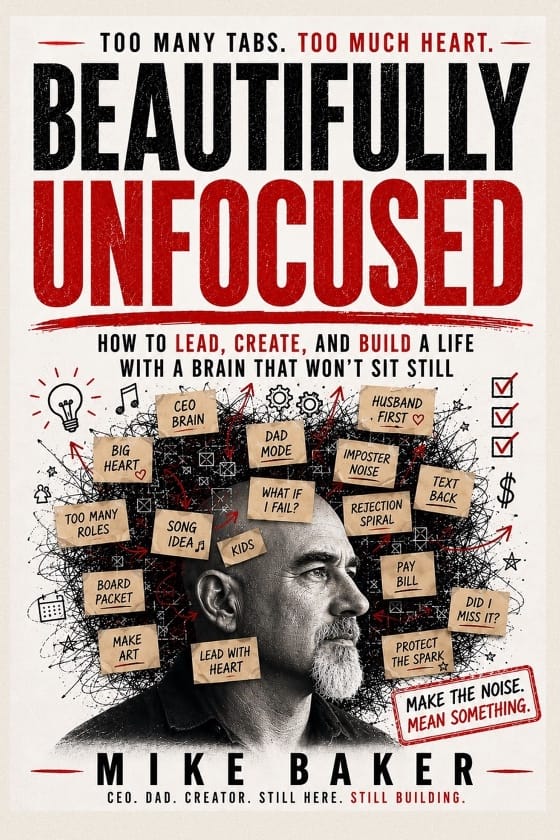
My brain does not wake up gently. It wakes up with too many tabs open: work, a song lyric, an unanswered text, an old embarrassment, a household task, a new project, and a completely unnecessary question that suddenly feels urgent. That can be funny. It can also be exhausting, especially when the world interprets overload as laziness and scattered attention as a lack of care.
For years, the gap between what I could do and what I struggled to do carried its own shame. I could lead serious work, recognize patterns quickly, create music, write, solve problems, and move clearly in a crisis. Then I could lose my keys, miss an ordinary detail, underestimate time, avoid a two-minute task, or leave someone I love carrying the impact of something my brain dropped.
Beautifully Unfocused exists to tell the whole truth about that contradiction. A fast, curious, sensitive brain can see connections other people miss. It can bring energy, empathy, creativity, humor, and courage into a room. The same brain can overcommit, interrupt, chase novelty, lose track of time, react at full volume, and create cleanup for other people when the systems are weak.
This is not a book about turning ADHD into a cute personality trait or a flawless superpower. The gift is real, and the cost is real. Intent matters, and impact still has to be faced. The work is learning to protect what is alive and useful in a loud brain while building enough structure that the people around us are not asked to absorb the cost.
That work reaches far beyond personal productivity. It changes marriage, parenting, friendship, leadership, creative work, healthcare, and the ordinary maintenance of a home. A passing idea from a leader can become someone else’s surprise assignment. A forgotten task can feel like disrespect. An emotional first wave can become the weather in the room. Language helps explain the pattern, but responsibility is what rebuilds trust.
The answer is not more shame. Shame opens more tabs and makes repair harder. The answer is honest design: external calendars, visible reminders, decision logs, landing places, body doubling, clear ownership, fewer steps, better pauses, direct apologies, and systems built for the person who actually has to use them on a tired Tuesday.
The book also makes room for care. Medication, therapy, coaching, sleep, movement, relationships, and professional guidance may all belong in a person’s support system. Needing handrails does not make a brain weak. It means memory, urgency, good intentions, and last-minute panic are not sturdy enough to carry an entire life alone.
This book is for people who have felt brilliant and overwhelmed in the same afternoon. It is an invitation to name the noise, understand the messy magic and the real cost, lead with more clarity, repair what lands on others, and build a life your brain can actually use—without giving up the spark that made the life yours.
The work is learning how to protect the gift without making other people absorb the cost.
Who it's for
This book is for adults with ADHD, people who suspect their brain may work this way, and the partners, parents, friends, coworkers, and leaders who love or work beside them. It is especially for creative people, founders, executives, caregivers, artists, builders, and late-night idea chasers who need practical structure without being flattened into someone else’s definition of normal.
Who it's not for
This book is not a diagnostic tool, treatment plan, medication guide, productivity miracle, or excuse for harmful impact. It does not claim every reader needs the same label or support. It combines lived experience with general education and practical reflection; medical and mental-health decisions belong with qualified professionals.
Questions it answers
- Why can a capable person handle complex work and still feel defeated by ordinary tasks?
- How do overload, executive dysfunction, time blindness, novelty, and shame reinforce one another?
- What is useful about hyperfocus—and how can it become costly?
- How do rejection sensitivity and full-volume emotions affect relationships and work?
- How can a fast-brained leader share ideas without creating confusion or accidental assignments?
- What guardrails protect memory, pace, clarity, ownership, and emotional steadiness?
- How do you build systems for the person you are instead of the fantasy person you keep failing to become?
- Why do visible environments, body doubling, and external calendars make starting easier?
- What does a real apology sound like when ADHD has affected someone else?
- How can a person protect the gift of a loud brain without making other people absorb the cost?
Inside
Part One, Name the Noise, gives language to too many open tabs, overload mistaken for laziness, the shame of being smart and scattered, time blindness, boring-task resistance, lost objects, masking, and rejection sensitivity.
Part Two, The Messy Magic and the Real Cost, follows the dopamine pull of a phone, boss-fight tasks, hyperfocus, idea infatuation, unfinished brilliance, emotional intensity, music, crisis clarity, and the moment personal patterns become someone else’s experience.
Part Three, Lead with a Loud Brain, brings ADHD into the meeting room. It separates vision from follow-through, urgency from sustainable pace, delegation from accidental hoarding, ideas from assignments, and a leader’s emotional weather from the team’s work.
Part Four, Build the Life Your Brain Knows How to Use, turns insight into design: honest systems, external calendars, environments as second brains, body doubling, medication and professional care, homes for repeating problems, repair, and AI used as an external brain.
The closing chapters connect the book to the companion album, name how women and girls have often been missed, and define beautifully unfocused as a life with direction, support, responsibility, return, and room for a mind that does not move in straight lines.
Before you start
This book discusses ADHD, executive dysfunction, overwhelm, shame, masking, rejection sensitivity, anxiety, depression, trauma, sleep, medication, substance use, emotional dysregulation, impulsivity, phone and dopamine-driven habits, conflict, missed responsibilities, relationship strain, parenting, workplace pressure, leadership impact, burnout, medical care, and the historic underrecognition of ADHD in women and girls. It includes personal stories and general education, not diagnosis or medical, psychological, legal, financial, or professional advice. Readers with questions about symptoms, medication, safety, or treatment should consult a qualified professional.
A note from me
I wrote this as a husband, dad, CEO, writer, musician, creator, and person with a loud brain—not as a doctor, therapist, pharmacist, psychologist, coach, or neuroscientist. I know the relief of finally having language for the way your brain has been moving, and I know language is only useful when it helps us live more honestly.
ADHD has helped me see patterns, create, connect, lead in a crisis, and make meaning from scattered pieces. It has also made me miss details, avoid boring work, overcommit, move too fast, and leave people I love or lead carrying consequences I did not intend. I will not romanticize the cost, and I will not bury the gift in shame.
The most useful shift has been to stop treating my mind like a reliable storage unit and stop designing systems for an imaginary version of myself. The calendar has to be external. Important thoughts need a place to land. Repeating problems need a home. My fast ideas need translation. My first emotional wave sometimes needs a pause.
Support is not failure. Reminders, calendars, labels, baskets, shared lists, body doubling, medication, therapy, coaching, honest conversations, and people willing to tell the truth can all be handrails. The right combination is personal, and qualified care matters when health questions are involved.
You may drift. I do. The practice is return: capture the thought, choose the next physical action, clarify what you meant, apologize for what landed, rebuild the system, and come back without turning one hard moment into a verdict on your entire character. Your brain can move differently and your life can still have direction.
How this book was made
AI-assisted tools helped with organization, structure, language, and revision. The lived experience, the voice, the judgment calls, and every final edit are mine. I say so here for the same reason I say it anywhere else — you should not have to wonder.
The full position is on the AI creative disclosure page.
First edition, 2026 · Published by Mike Baker HQ
Read chapter one free
Your Brain Has Too Many Tabs Open
Chapter one of Beautifully Unfocused is free to read right here on the page. No download, no card, nothing to install. Sign up with your email and the chapter opens on this page. It also puts you on Just an Ordinary Tuesday, my newsletter, and you can leave that anytime.
You’re signed in, so chapter one is open below. Tap the page or use the arrows to turn.
Continue reading
- Human First. Carries the same commitment to dignity, accountability, and systems that serve people instead of swallowing them.
- The Optimist’s Way. Offers an honest practice of hope for people learning to return, rebuild, and keep moving without denying what is hard.
- Still Here, Still Trying. Continues the conversation about being a man, husband, father, and human being who is unfinished and still doing the work.
Print it, fill it in by hand, keep it somewhere you will actually see it.
The Brain-Friendly Task MapThe Friction AuditThe Idea Parking LotThe Emotional Weather MapThe Actual User Manual Download the workbook (PDF) →
Companion work
Beautifully Unfocused — the album
I wrote an album alongside this book, out of the same material. Twelve songs, same title.
Go to the album →