Why this book exists
Most men were never taught enough about women’s bodies. We picked up fragments about puberty and reproduction, then somehow became husbands, partners, fathers, friends, coworkers, and leaders without learning much about periods, pain, perimenopause, menopause, pelvic health, sleep disruption, desire shifts, or the ways women are expected to keep a whole life moving while their bodies change the rules.
That missing education follows us home. It shows up when a husband treats a hot flash like a thermostat dispute, hears exhaustion as rejection, answers brain fog with impatience, or turns a hard conversation about sex into a referendum on whether he is still wanted. He notices the symptom that touches him first and mistakes it for the whole story.
I wrote this book because men are teachable. Most of us are not trying to be cruel. We love our wives and partners, and we want to be decent men. We also have a remarkable ability to walk into a vulnerable moment with one underqualified theory, one badly timed joke, and a facial expression that adds forty minutes to the argument.
The answer is not shame. It is better language, more useful information, steadier attention, and the humility to ask what kind of support would help before charging in with a solution. Men need a guide that tells the truth without making women do all the teaching. Couples need a bridge back into conversations that have become loaded, lonely, or too easy to avoid.
Kellie is at the heart of this book. Marriage keeps asking us to learn the person in front of us now, not only the person we first fell in love with. Midlife makes that lesson impossible to ignore. Bodies, sleep, roles, health, sex, work, family demands, and ordinary patience all change. Love has to keep learning too.
This book uses humor because midlife is weird and pretending otherwise helps no one. The joke, however, is never that women are irrational, dramatic, broken, difficult, or too much. The target is the undertrained husband entering a major body transition with the preparation level of a raccoon operating a forklift.
The practical work is simple to name and harder to live: believe her before the symptoms become undeniable, carry more without waiting for instructions, support qualified care without becoming the medical director of the living room, talk about sex without pressure, repair faster, take care of your own health, and stay close without hovering or making her manage your feelings.
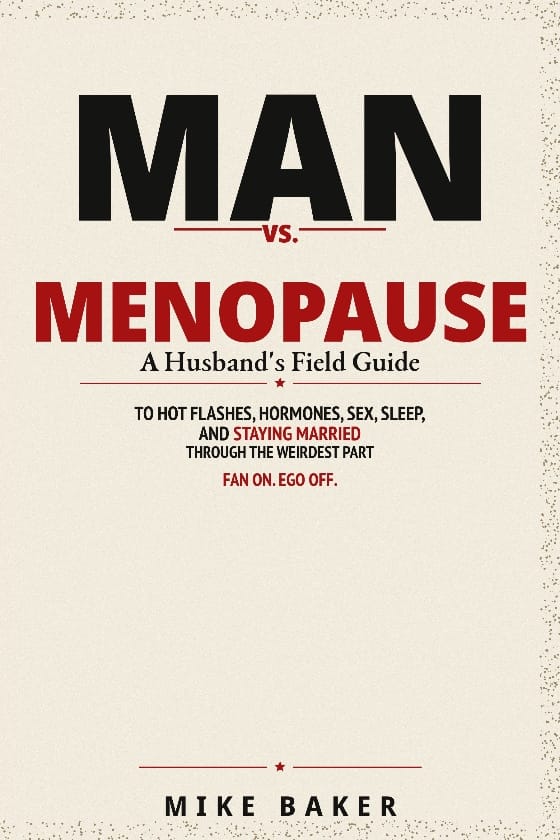
Man vs. Menopause exists to help a husband become less hazardous and more helpful. Not perfect. More attentive. More mature. Easier to trust. The kind of man who notices, learns, adjusts, laughs without cruelty, and makes the life around the woman he loves a little lighter.
The body changes are hard enough. Make the life around her softer.
Who it's for
This book is for husbands and partners who love a woman moving through perimenopause, menopause, or midlife health changes and want to understand what is happening without making her teach every lesson. It is for the man who feels confused, worried, rejected, helpless, or embarrassed by the conversation and is willing to become better support. It is also for women deciding whether this is a safe, useful book to hand to the man beside them.
Who it's not for
This book is not a medical textbook, diagnostic tool, treatment plan, or substitute for individualized care from a qualified clinician. It does not treat all women, bodies, symptoms, relationships, or treatment preferences as the same. It is not permission for a husband to diagnose from the couch, police a woman’s choices, or explain her own body back to her.
Questions it answers
- What is the difference between perimenopause and menopause?
- How can hot flashes, sleep loss, brain fog, anxiety, bleeding changes, and rage affect everyday life?
- How do I ask what kind of support she needs without making her manage me?
- What should I understand about changing desire, painful sex, dryness, and intimacy?
- How do I support doctor visits and treatment decisions while staying in my lane?
- What should I stop saying if I want peace and trust in the house?
- How do invisible labor and household responsibility affect this stage?
- What do I do when I feel left out, rejected, or confused?
- How do I take care of my own health without giving her one more person to manage?
- What does it look like to stay close while both people are changing?
Inside
The opening gives husbands an honest orientation: why the book exists, what it can and cannot do, how to use it in the middle of real life, and why the first goal is to become less hazardous and more helpful.
Part One, What the Hell Is Happening?, explains perimenopause, menopause, hormones, hot flashes, sleep, brain fog, ADHD, anxiety, rage, and bleeding changes in plain language. The point is not to turn a husband into an expert. It is to give him enough understanding to stop dismissing what he does not recognize.
Part Two, Her Body, Her Care, and Your Mouth, moves into body changes, sex, desire, medical appointments, hormone therapy, supplements, and the broader landscape of midlife women’s health. It keeps treatment decisions where they belong: with the woman and a qualified clinician who knows her history.
Part Three, The Marriage Part, addresses household labor, damaging phrases, a husband’s feelings of rejection or confusion, and the habits that make him easier to trust. Bonus chapters turn back toward his own health, romance, dates, and kindness in both directions.
The book closes with an actual quick-reference field guide for what to say, what to do, what to buy, and when to stop talking, followed by The Man Who Stays Close, medical sources, and practical resources for readers who need trustworthy next steps.
Before you start
This book discusses perimenopause, menopause, menstruation, heavy and irregular bleeding, pelvic pain, vaginal dryness, painful sex, urinary symptoms, fertility and reproductive history, body image, sleep disruption, anxiety, depression, rage, relationship strain, medical dismissal, hormone therapy, medications, supplements, and thoughts of self-harm. It includes candid sexual and anatomical language and strong humor. It is educational and relational, not medical, diagnostic, therapeutic, or clinical advice. Severe, sudden, concerning, worsening, or life-disrupting symptoms deserve care from a qualified clinician. If someone is in immediate danger or may hurt themselves, contact emergency services; in the United States, call or text 988.
A note from me
I did not write this as a medical expert. I wrote it as a husband trying to learn out loud, laugh at himself, love his wife well, and help other men become less hazardous inside the homes they share with women they love.
Kellie has taught me that marriage is not something we understand once and then coast through. It keeps asking us to pay attention. It asks us to see the person in front of us now, not only the version we first met. It asks for tenderness when bodies change, honesty when silence would be easier, and humor that never makes the person carrying the hard thing become the joke.
I have said the wrong thing. I have tried to solve when I should have listened. I have missed work that was already visible because someone else kept carrying it. The answer is not to collapse into shame and make her comfort me. The answer is to notice, apologize cleanly, carry more, and do better in the next ordinary moment.
My hope is that a man can read this book and become easier to trust. That a woman can hand it to him and feel respected. That a couple can talk sooner, laugh more honestly, touch with more care, and find their way back toward each other while life and bodies keep changing.
Stay close. Not clingy. Not hovering. Close enough to notice, believe, learn, help, repair, and keep choosing each other.
First edition, 2026 · Published by Mike Baker HQ
Read chapter one free
Perimenopause Is the Plot Twist Before the Plot Twist
Chapter one of Man vs. Menopause is free to read right here on the page. No download, no card, nothing to install. Sign up with your email and the chapter opens on this page. It also puts you on Just an Ordinary Tuesday, my newsletter, and you can leave that anytime.
You’re signed in, so chapter one is open below. Tap the page or use the arrows to turn.
Continue reading
- Believe Her the First Time. Carries the work of believing women’s pain into practical support, advocacy, and care.
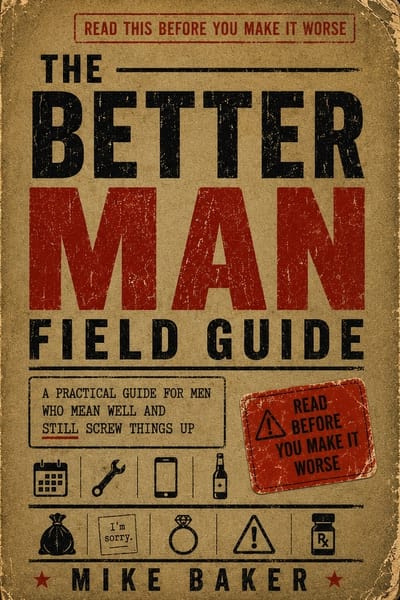
- The Better Man Field Guide. Continues the work of humility, repair, responsibility, and becoming a man other people do not have to manage.
- Still Here, Still Trying. Explores the honest work of staying present and continuing to choose the people you love when life stops following the plan.
Print it, fill it in by hand, keep it somewhere you will actually see it.
The Symptom-and-Support MapThe Sleep and Home ResetThe Words Before the WordsThe Intimacy ResetThe Guy She Is Glad Is There Download the workbook (PDF) →